Stay in the loop!
Get the latest industry insights delivered straight to your inbox
The temperature danger zone is 41°F to 135°F, where bacteria grow fast enough to make food unsafe. Here are the time limits, cooling and reheating rules, a °F and °C chart, and what the 2026 FDA Food Code changes for operators.
TransAct Technologies
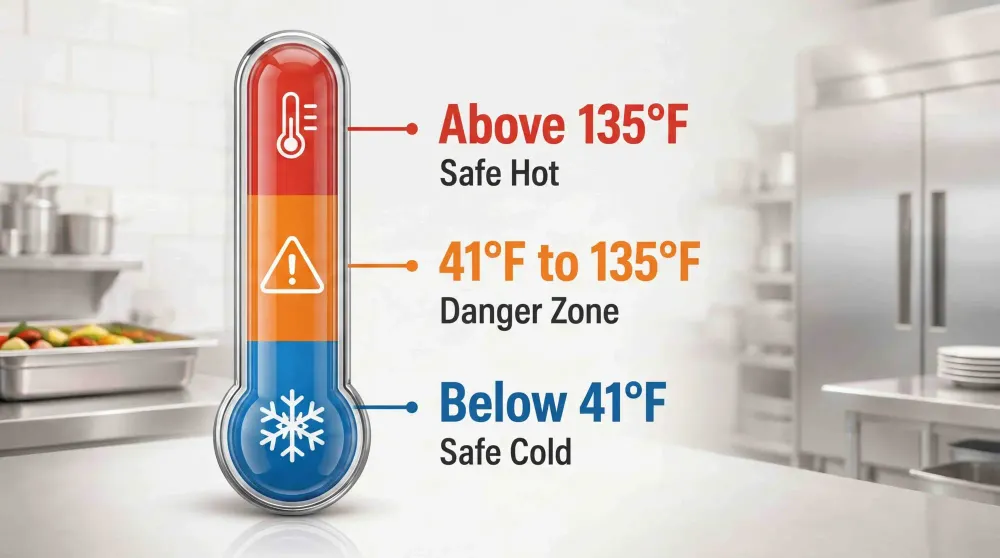
The temperature danger zone is the range between 41°F and 135°F (5°C and 57°C), where bacteria in food multiply fast enough to make people sick. Under the FDA Food Code, any food that needs time and temperature control for safety should spend as little time in this range as possible. The longer it sits there, the more risk stacks up.
Cold food belongs at 41°F or below and hot food at 135°F or above (§ 3-501.16), and those are usually the first numbers a health inspector checks. The limits are unchanged from the 2022 edition and carry into the 2026 Food Code. The goal of temperature control comes down to two ideas. Keep food out of the zone during storage and holding, and move it through the zone as fast as possible when you have no choice, such as during cooking, cooling, and reheating.
| Control Point | Fahrenheit | Celsius | Time Limit | Food Code Section |
|---|---|---|---|---|
| Cold holding | 41°F or below | 5°C or below | Continuous | § 3-501.16 |
| Temperature danger zone | 41°F to 135°F | 5°C to 57°C | As short as possible | § 3-501.16 |
| Fastest bacterial growth | About 70°F to 125°F | About 21°C to 52°C | Avoid entirely | n/a |
| Hot holding | 135°F or above | 57°C or above | Continuous | § 3-501.16 |
| Cooling, stage 1 | 135°F to 70°F | 57°C to 21°C | Within 2 hours | § 3-501.14 |
| Cooling, stage 2 | 70°F to 41°F | 21°C to 5°C | Within the next 4 hours (6 total) | § 3-501.14 |
| Reheating for hot holding | 165°F for 15 seconds | 74°C for 15 seconds | Within 2 hours | § 3-403.11 |
| Time as a public health control | Starts at 135°F+ or 41°F or below | Starts at 57°C+ or 5°C or below | 4 hours, then serve or discard | § 3-501.19 |
| Time control, cold-only option | Starts at 41°F or below, never above 70°F | Starts at 5°C or below, never above 21°C | 6 hours, then discard | § 3-501.19 |
| Date marking, ready-to-eat TCS food | Held at 41°F or below | Held at 5°C or below | 7 days max, day of prep is day 1 | § 3-501.17 |
Free download: Get the Safe Temperatures Wall Card, a one-page, print ready version of this chart sized for a kitchen wall.
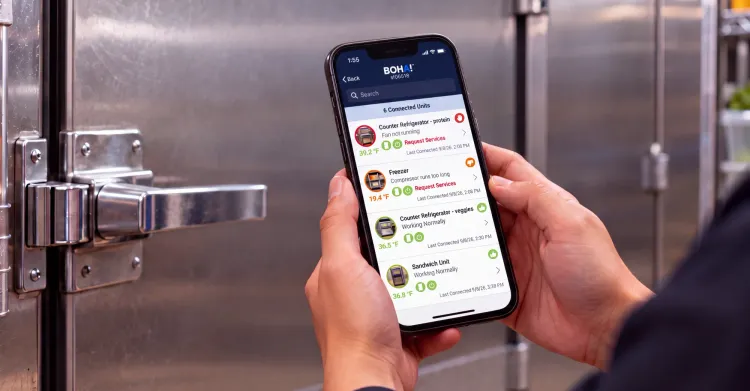
Holding these limits across dozens of locations? BOHA! Temp and BOHA! Sense record temperatures automatically and flag a drifting unit before product is lost.
Foodborne pathogens are living organisms, and 41°F to 135°F happens to sit close to their ideal comfort zone. Given moisture and nutrients, common culprits like Salmonella, E. coli, Listeria, and Clostridium perfringens can double in number roughly every 20 minutes under favorable conditions, according to USDA Food Safety and Inspection Service.
Growth is fastest in the middle of the range, roughly 70°F to 125°F, which is why food left on a prep table or in a warm delivery vehicle carries more risk than food that briefly passes through the outer edges of the zone. One bacterium doubling every 20 minutes becomes millions within hours.
It also explains a practice that confuses new hires: why cooling is treated more strictly than cooking. Cooking drives food through the zone quickly. Cooling, if you let it happen passively, leaves a large mass of food sitting in the fastest-growth band for hours.
Operators often notice that a poster in the break room says 40°F to 140°F while the health inspector talks about 41°F to 135°F. Both are correct for their audience.
The FDA Food Code range of 41°F to 135°F is the foodservice standard, and it is what your local health department enforces in a commercial kitchen. The USDA FSIS range of 40°F to 140°F is the wider, more conservative version used in consumer education, where there is far less oversight of how people handle food at home.
The same consumer guidance is the source of the familiar 2-hour rule: don't leave perishable food out of refrigeration for more than 2 hours, or 1 hour with the air is above 90°F. For a home kitchen, that’s sound advice. A commercial kitchen should follow the Food Code’s time controls described below, which come with their own marking and documentation requirements.
One quick audit for your locations: any chart, training deck or laminated card that still shows 45°F as the cold-holding limit is out of date. Current Food Code editions require 41°F, and the older allowance for 45°F in existing refrigeration equipment is gone.
Not every food carries the same risk. The ones that do are called TCS foods, short for Time/Temperature Control for Safety. They support rapid bacterial growth because of their moisture, protein content, and low acidity.
Shelf-stable items like dry pasta, unopened canned goods, and most breads are not TCS until they are prepared or opened. Once a commercially processed TCS food is opened, it follows the same rules as anything made from scratch. The full list, including the foods that surprise people, is in our TCS foods guide.
Temperature control does not begin at the cooler door. It begins at the delivery door.
Under the Food Code, cold TCS foods should generally be received at 41°F or below (a few items, such as milk and shell eggs, have a 45°F allowance), and hot TCS foods at 135°F or above. Frozen product should arrive frozen solid, with no signs of thawing and refreezing, such as ice crystals or liquid in the case bottom.
Checking product temperature at receiving is one of the highest-leverage habits in a kitchen, and one of the most frequently skipped when a truck arrives during a rush. A case of chicken that shows up at 50°F has already spent unknown time in the zone before it ever entered your building, and no amount of downstream discipline undoes that. That’s why receiving checks belong on the same required checklist as opening and closing tasks.
Food doesn’t become unsafe the moment it enters the danger zone. Risk depends on how long it stays there, which is the logic behind the Food Code provision called time as a public health control (§ 3-501.19). It lets an operator hold TCS food without temperature control under two options:
Both options require written procedures the health department can review and a mark on each container showing when time runs out. Neither lets you put the food back in the cooler to reset it, so once the time is up, it goes in the trash.
Two details trip up teams most often. The clock covers every stretch of time the food spends out of temperature control, across prep, staging, transport and service, so short gaps add up. And even though the discard point is 4 hours, checking hot and cold holding every 2 hours leaves time to catch a drifting temperature before product is lost.
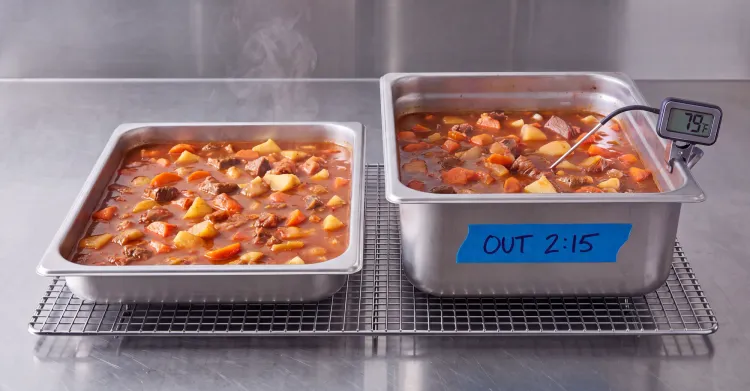
The FDA has consistently identified excessive cooling time as one of the leading contributing factors to foodborne illness, because a large volume of hot food takes a long time to pass through the danger zone. You cannot drop a full pot of chili into the walk-in and call it done. The core will sit in the fastest-growth band for hours while the surface looks fine.
The Food Code (§ 3-501.14) requires two-stage cooling: from 135°F to 70°F within 2 hours, then from 70°F to 41°F within the next 4 hours.
That gives you 6 hours total, but Stage 1 is the hard gate. If the food has not reached 70°F within the first 2 hours, it must be discarded, or fully reheated to 165°F and the cooling process started over.
Passive cooling almost never meets that gate on its own. The methods that do:
A tightly covered, deep container placed straight into the walk-in.
The lid traps heat and moisture inside, the container’s depth slows the core, and the mass warms everything around it.
The 2026 edition adds placing food at a depth of no more than 2 inches as a recognized cooling method (§ 3-501.15). It also lets the regulatory authority approve an alternative cooling method for cooked TCS food, including refrigeration with continuous electronic monitoring of time and ambient air temperature. Operators who already monitor walk-ins continuously should watch the second change closely. Both provisions apply only after your state or locality adopts the 2026 edition.
For temperature checkpoints, logging and the stage-2 mistakes behind most cooling failures, see our guide to the two-stage cooling rule.
When a cooled TCS food goes back out for hot holding, reheat it rapidly to 165°F for 15 seconds, within 2 hours (FDA Food Code 3-403.11). Use equipment designed to raise temperature: a stovetop, oven, or steam kettle. A steam table or warming well is built to hold hot food hot, not to bring cold food up through the zone, and using it to reheat is a classic violation.
From there, keep hot TCS food at 135°F or above and check it on a schedule. Hot holding is also where food waste builds up quietly, since the easiest way to avoid running out is to overproduce. Our guide to safe hot-holding temperatures without overproduction covers holding times and batch sizes that protect both safety and food cost.
The danger zone has a long-tail cousin that inspectors check constantly and teams routinely miss.
Under Food Code 3-501.17, ready-to-eat TCS food that is prepared on-site and held for more than 24 hours must be date marked with a discard date, and it may be held for a maximum of 7 days at 41°F or below, counting the day of preparation as day 1.
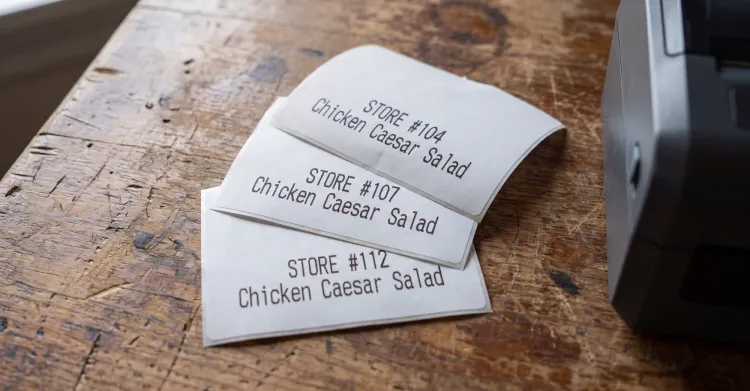
This is where temperature control and labeling stop being separate topics. The 7-day clock is invisible unless it is written on the container, which is exactly what a prep label is for. A kitchen with perfect holding temperatures and no date marking will still fail this check, and a guest is still at risk.
Every rule above depends on a number, and every number depends on a thermometer. Three habits protect that foundation.
Calibrate. Use the ice-point method: submerge the probe in a slush of ice and water, wait for the reading to settle, and confirm it reads 32°F. Recalibrate after a drop, after exposure to temperature extremes, and on a routine schedule. A thermometer that reads 4°F low turns a 45°F cooler into a “41°F” cooler on paper.
Clean the probe between readings. A probe that goes from raw chicken to a pan of rice without being washed and sanitized creates the cross-contamination problem it was meant to help prevent.
Measure the food, not the air. A cooler’s ambient display tells you what the air is doing, not what the food is doing. A walk-in reading 40°F can still hold a pan of chicken at 47°F if the door has been open, the pan was recently stocked, airflow is blocked, or hot food was set in to cool nearby. Internal product temperature, taken at the thickest part, answers the food safety question. Use air monitoring to catch equipment problems early and probe readings for your compliance logs.
In a single restaurant, one strong manager can keep a close eye on cooling and holding. Across dozens or hundreds of locations, that same discipline becomes a standardization problem, and the FDA's own data shows where it breaks.
In the agency’s most recent Retail Food Risk Factor Study of restaurants, cold holding was out of compliance in about 62% of fast food and 80% of full-service restaurants visited (2017 to 2018 topline summary).
That study also found that restaurants with a well-developed food safety management system had less than half as many out-of-compliance practices as those without one. The 2026 Food Code builds on that finding with a new section, § 8-201.15, describing when an establishment needs a written food safety management system, with four years to comply after a jurisdiction adopts the code and exemptions possible for minimal-risk operations. Adoption timelines vary widely, so check where your states stand.
Consider what a paper log actually proves. It proves that someone wrote a number down. It does not prove when they wrote it, whether they took the reading at the time they claim, or whether the pen came out at 6 a.m. on inspection day. Auditors know this, which is why documentation quality has become a differentiator rather than a formality. Our comparison of temperature logs that survive an audit covers what inspectors look for.
Refrigeration failures follow the same pattern. A walk-in trending warm at 2 a.m. is a service call if someone is alerted, and a discard event if it’s discovered at 7 a.m. That’s the case for remote temperature monitoring: the record builds itself, and the alert reaches someone while there’s still time to act.
BOHA! connects the monitoring, checks, labels and reporting that the rules above depend on, so each location follows the same process and the record builds itself.
The result is consistent execution at every location and less time spent filling in logs. For how these fit with checklists and corrective actions, see our food safety and compliance overview.
Put the numbers on the wall. Download the free Safe Temperatures Wall Card for every prep line, or see how BOHA! monitors temperatures across every location.
The temperature danger zone is the range between 41°F and 135°F (5°C and 57°C), where bacteria grow quickly enough to make food unsafe. The FDA Food Code requires TCS foods to spend minimal time in this range.
Under the FDA Food Code it is 41°F to 135°F. The USDA uses a wider 40°F to 140°F range in consumer-facing guidance, but the FDA range is the one enforced in commercial kitchens.
Under the FDA Food Code, the temperature danger zone is 5°C to 57°C (41°F to 135°F). The USDA’s consumer guidance uses 4°C to 60°C (40°F to 140°F).
Under the FDA Food Code’s time as a public health control provision, TCS food held without temperature control can stay out for up to 4 hours, after which it must be cooked and served, served, or discarded. Cold food that starts at 41°F or below and never exceeds 70°F can be held for up to 6 hours.
4 hours. The food must start at 135°F or above, be marked with the time it was removed from temperature control, and be served or discarded within 4 hours, and the operation needs written procedures for the practice.
6 hours total. Food must cool from 135°F to 70°F within the first 2 hours, then from 70°F to 41°F within the next 4 hours. If it misses the 2-hour mark, it must be discarded or reheated to 165°F and cooled again.
TCS foods include cooked rice and grains, meat, poultry, seafood, dairy, shell eggs, cut leafy greens, cut melons, cut tomatoes, and cooked vegetables. They require time and temperature control because they support rapid bacterial growth.
Not completely. Cooking to the required temperature kills most active bacteria, but it can’t undo everything that happened before. Some bacteria, such as Staphylococcus aureus, leave behind toxins that heat won’t destroy, and spore-forming bacteria like Clostridium perfringens can survive cooking and multiply again as food cools. So cooked food starts a new control step, not a clean slate: hold it at 135°F or above, or cool it from 135°F to 70°F within 2 hours and to 41°F within 6 hours total. Food held under time as a public health control never resets. It’s served or discarded within 4 hours of leaving temperature control.
Cool from 135°F to 70°F within 2 hours, then from 70°F to 41°F within the next 4 hours, for 6 hours total. The 2-hour Stage 1 gate is the hard limit. Food that misses it must be discarded or fully reheated and cooled again.
When it exceeds the time allowed: 4 hours without temperature control, 6 hours for cold food under the cold-only option (or as soon as it rises above 70°F), or 2 hours into cooling without reaching 70°F unless it’s reheated and cooled again.
Cold TCS food should be held at 41°F or below. Many operators target 38°F or below to build a safety margin against equipment drift and door openings.
Ready-to-eat TCS food prepared on-site and held longer than 24 hours must be date marked and may be held a maximum of 7 days at 41°F or below, counting the preparation day as day 1.
No. Re-chilling doesn’t reverse bacterial growth, and cooking doesn’t make time-abused food reliably safe, because some bacteria, including Staphylococcus aureus and Bacillus cereus, produce toxins that heat doesn’t destroy. Food that has exceeded its time limit should be discarded.
No. The 41°F and 135°F limits, cooling times, reheating requirements and date marking rules are unchanged. The 2026 edition adds a 2-inch depth cooling method, a path for approving an alternative cooling method that uses continuous electronic monitoring, and a requirement for a written food safety management system in covered establishments.
Get the latest industry insights delivered straight to your inbox
Browse