Stay in the loop!
Get the latest industry insights delivered straight to your inbox
The two-stage cooling process takes cooked food from 135°F to 70°F within 2 hours and to 41°F or below within 6 hours total. Here is where kitchens miss the 70°F checkpoint, the methods that work and what the 2026 FDA Food Code adds.
TransAct
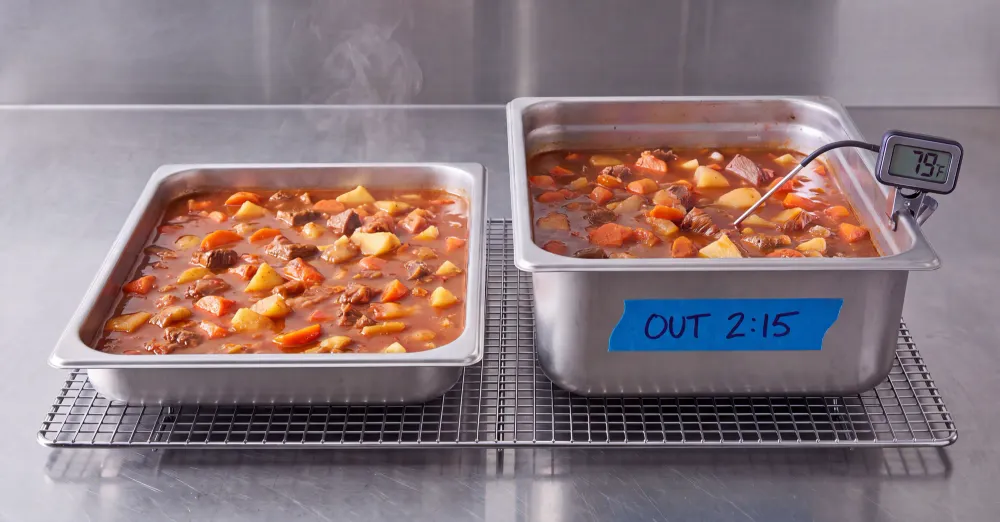
The two-stage cooling process is the FDA Food Code rule for cooling cooked time/temperature control for safety (TCS) food: cool it from 135°F to 70°F within 2 hours, then to 41°F or below within 6 hours total. Time saved in the first stage carries over, so food that reaches 70°F in 1 hour has up to 5 more hours to reach 41°F.
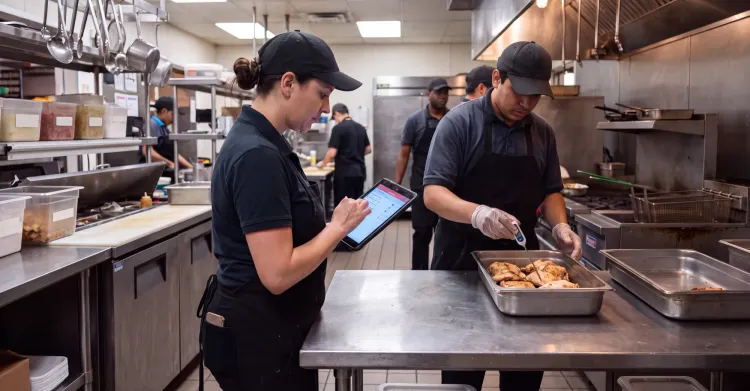
Most kitchen teams can recite that rule. Where they slip is the checkpoint in the middle: if nobody takes a reading at the 2-hour mark, a batch that missed 70°F keeps cooling as if nothing happened. This guide covers why the rule splits at 70°F, where real kitchens miss the checkpoint, what the 2026 Food Code changes and how multi-location operators make the check happen every time.
The split follows how bacteria grow. Within the temperature danger zone of 41°F to 135°F, growth is fastest between roughly 125°F and 70°F, so the first stage forces food through that band quickly and the second stage finishes the job more gradually. A batch that cools slowly but steadily, taking three hours to reach 70°F, has already failed the rule, even if it reaches 41°F well inside 6 hours.
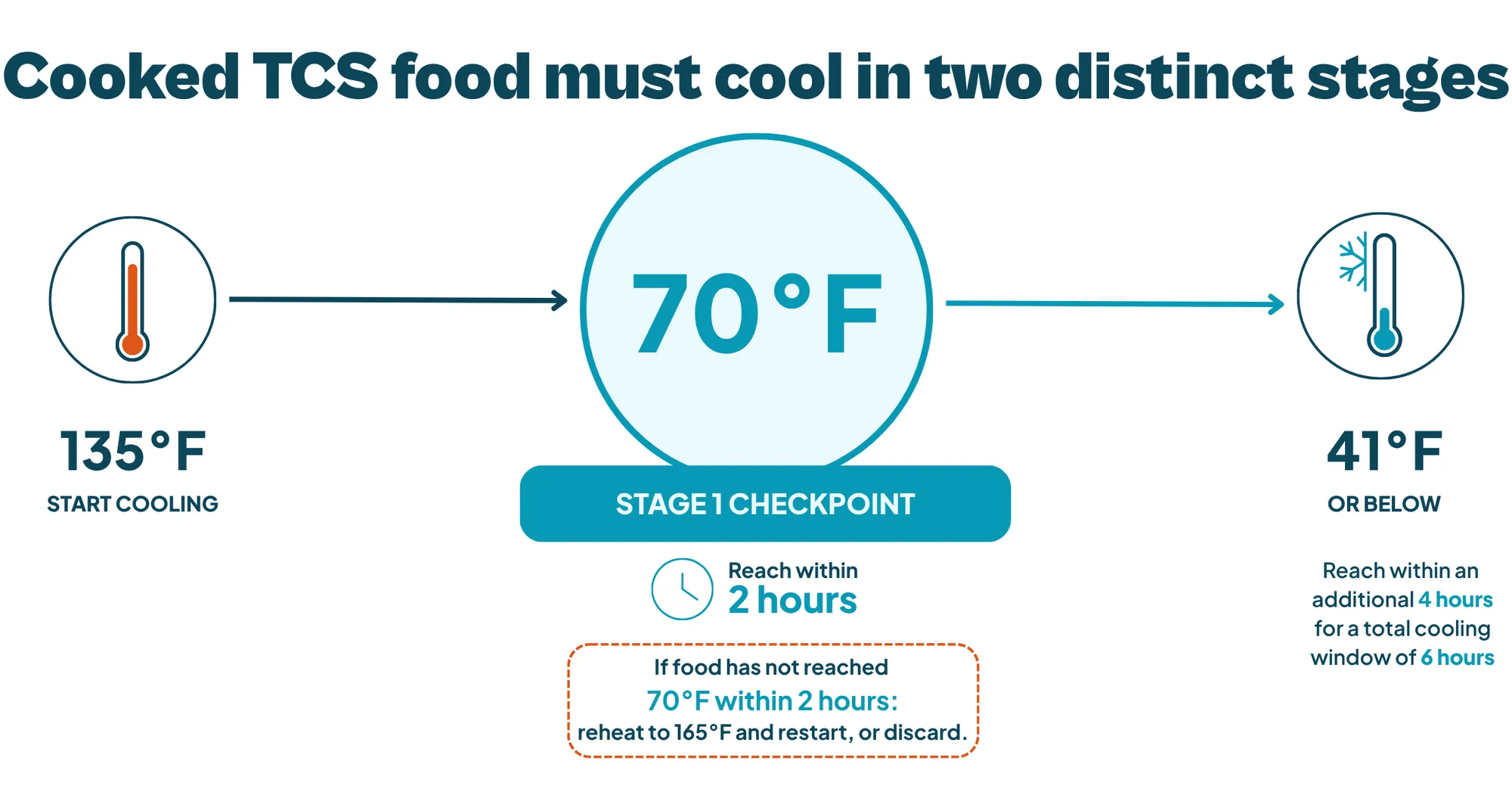
If food hasn’t reached 70°F at the 2-hour mark, it can’t simply keep cooling. The accepted corrective action is to reheat it to 165°F and start the cooling clock over, or discard it. Food that reaches 70°F on time but is still above 41°F at the 6-hour mark should be discarded. There’s no partial credit for close enough.
Not every TCS food goes through two stages. Food prepared from ingredients at room temperature, such as tuna salad or reconstituted foods, must cool to 41°F or below within 4 hours. The same 4-hour limit applies to TCS food that was legally delivered above 41°F, such as milk or shell eggs received at up to 45°F (§ 3-501.14).
The rule itself is simple to state. What consistently trips up real kitchens is a handful of specific, physical mistakes that have nothing to do with understanding the rule and everything to do with how food is actually handled during the cooling process.
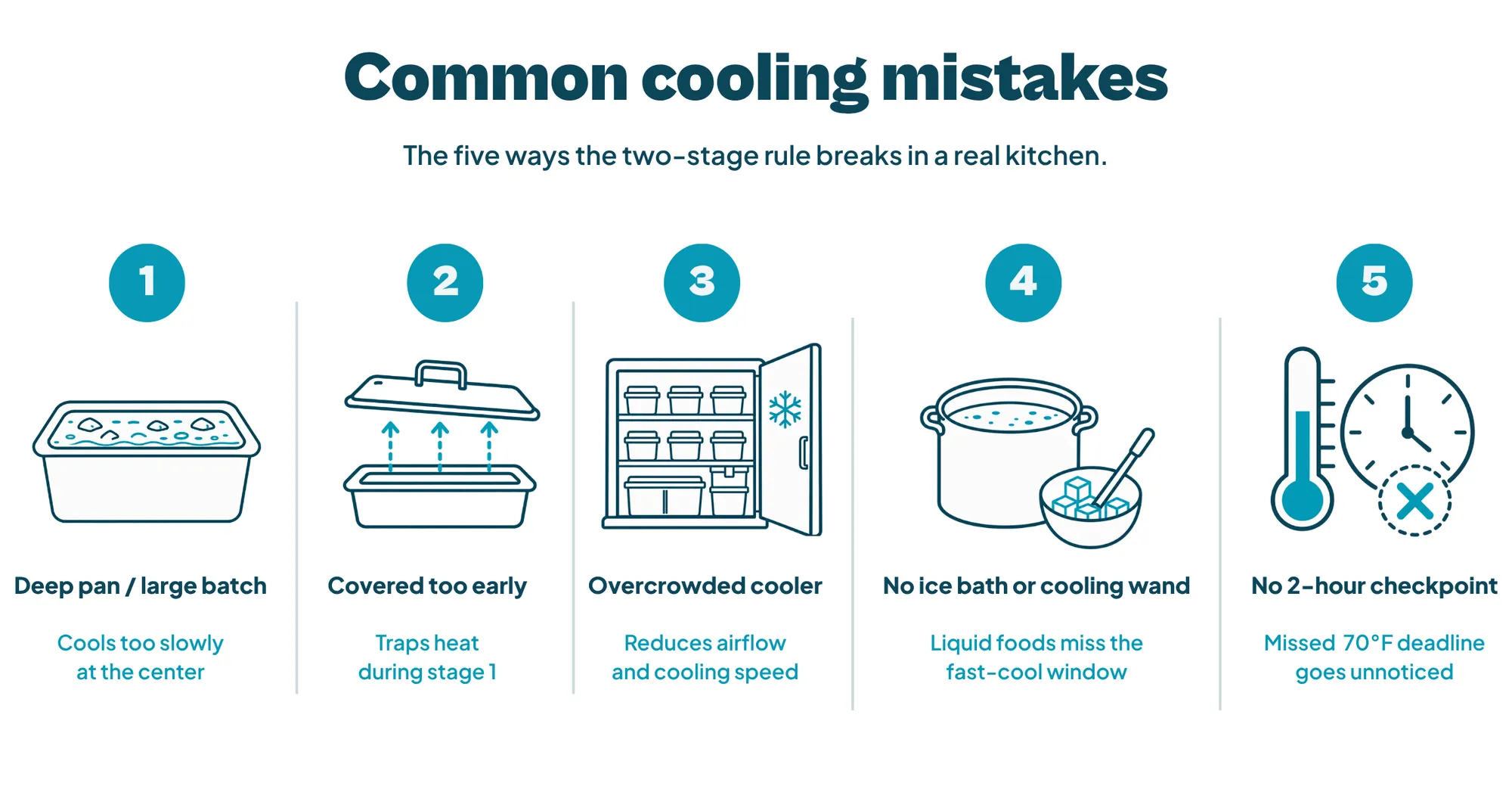
Batch size that's too large for the cooling method. A deep, tightly packed pan of chili or stew insulates itself. The center of a four-inch-deep pan can take hours longer to reach 70°F than the edges, even though a probe thermometer touched near the surface might suggest it's cooling on schedule. Splitting large batches into smaller, shallower pans is one of the single highest-impact fixes available, and one of the most commonly skipped, because it takes more pan space and more handling.
Covering food too early. It's a natural instinct to lid a pan of hot food before putting it in the walk-in, both for cleanliness and to avoid dripping onto other items. But a tight lid traps heat and slows cooling exactly during the highest-risk window. The Food Code allows food to stay loosely covered or uncovered while it cools, as long as it’s protected from overhead contamination, so cover it once it’s through the first stage.
Overcrowding the cooler during the cooling window. A walk-in that's already near capacity struggles to pull heat out of a new pan of hot food efficiently, which slows the whole batch's descent through both stages. Reserving specific cooler space, or using a blast chiller, for actively cooling items, separate from already-cold storage, keeps the highest-risk items cooling at the rate they need to.
No ice bath or cooling wand for liquid-based items. Soups, sauces, and stocks cool far faster in an ice bath with occasional stirring than sitting in a cooler on their own. Skipping this step for the sake of time during a busy shift is one of the most common ways a stage-one deadline gets missed.
No second checkpoint. Teams that check temperature once, at the start of cooling, and again at the end of service prep the next day, have no way of knowing whether the two-hour, 70°F checkpoint was actually hit. Without a mid-process check, a missed stage-one deadline is invisible until it's already too late to correct.
The 2026 FDA Food Code keeps both cooling limits from the 2022 edition. What changes is the list of approved cooling methods in § 3-501.15, which already includes shallow pans, smaller portions, ice baths, rapid-cooling equipment and adding ice as an ingredient.
Neither change applies until your state or locality adopts the 2026 edition, and adoption takes years in many places. Stores in different states may follow different editions for a while, so write one cooling procedure that meets the stricter rule and check where your states stand.
Cooling failures aren't a hypothetical risk. CDC national outbreak data tracking contributing factors to foodborne illness outbreaks from 2014 through 2022 shows improper cooling holding fairly steady as a contributing factor across the first two periods studied, at 9.4% (2014-2016) and 8.8% (2017-2019), before jumping to 10.9% in the most recent period (2020-2022). For bacterial outbreaks specifically, improper cooling wasn't even in the top five contributing factors in the earlier two periods, but climbed to 17.3% in 2020-2022, a significant enough shift that it's worth every multi-location operator's attention, not just a compliance footnote.
That increase doesn't have one single explanation, but it lines up with a period of significant labor turnover and staffing pressure across foodservice, exactly the conditions that make a two-stage process with a mid-window checkpoint easy to skip when a kitchen is short-staffed and moving fast.
The fix isn't retraining staff on the rule itself, since most already know the basic shape of it. What's missing is building physical and procedural checkpoints that catch a miss before it becomes a six-hour failure discovered the next morning.
A mid-process temperature check, not just a start and end check. Someone needs to verify the 70°F mark was hit within two hours, logged with an actual time and temperature, not assumed.
A default maximum batch and pan-depth standard, so the cooling method itself doesn't quietly work against the timeline before anyone realizes it.
A clear, posted decision tree for a missed checkpoint: reheat and restart, or discard, with no ambiguity about which applies and who has the authority to make that call in the moment.
Cooling logged as its own event, separate from the hot-holding or storage log it eventually feeds into, so a review can isolate exactly where in the two-stage process a specific batch actually was at each checkpoint.
A single kitchen with a strong culture can hold this discipline through habit and hands-on supervision. Across dozens or hundreds of locations, that same discipline needs a system behind it, because the rule doesn't bend for a kitchen that's short-staffed, and an inspector reviewing site 40 isn't going to accept "we usually do it right" as documentation.
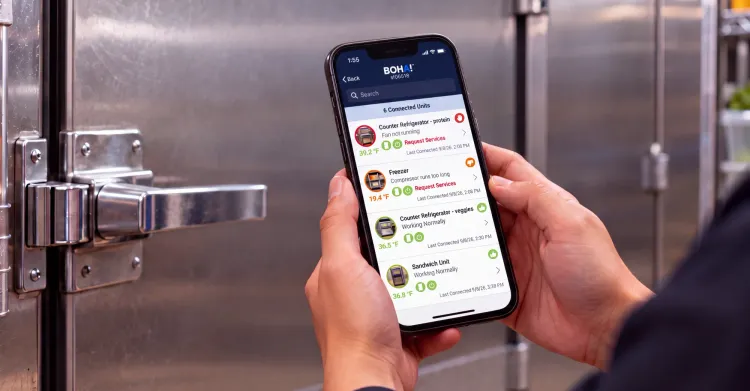
Connected temperature monitoring, like BOHA! Temp, can capture the mid-process 70°F checkpoint automatically rather than relying on a manual second check that's easy to skip during a busy shift, and it ties that reading to the same batch record as the initial cook temperature and the final cold-holding confirmation. Paired with a digital checklist step, like BOHA! Checklist, the posted decision tree for a missed checkpoint becomes part of the required workflow itself, rather than a laminated sheet on the wall that's easy to skip past when the kitchen is slammed.
That connected record is exactly what closes the gap this piece has been describing, a system that catches the exact moment a busy shift starts working against the checkpoint, instead of relying on someone remembering to check. For more on how that same connected approach applies to the broader temperature log program a location runs day to day, see Temperature Logs That Survive an Audit: Paper vs. Digital.
Cooling is one piece of a much larger temperature management picture that includes receiving, storage, hot-holding, and cold-holding, all governed by the same underlying temperature danger zone that defines the range between 41°F and 135°F where food safety risk climbs fastest. Getting the two-stage cooling rule right is one of the more operationally demanding pieces of that picture, precisely because it requires a mid-process checkpoint most teams aren't set up to catch, but it's also one of the highest-leverage fixes available, given how sharply improper cooling has climbed as a contributing factor to real outbreaks in the most recent CDC data. It's also the same principle behind TransAct's broader Food Safety & Compliance approach, building the checkpoint into the workflow itself rather than counting on someone to remember a posted rule.
Cooked TCS food must cool from 135°F to 70°F within two hours (stage one), then from 70°F to 41°F or below within an additional four hours (stage two), for a six-hour total cooling window.
Per the FDA Food Code, if food hasn't reached 70°F within the first two-hour window, it must be reheated to 165°F and the cooling process restarted, or discarded. It cannot simply continue cooling past the missed checkpoint.
Deeper, more tightly packed pans insulate the food at the center, slowing heat loss significantly compared to shallow pans. A deep pan can miss the two-hour, 70°F checkpoint even when a surface-level temperature reading looks fine, because the center is cooling much more slowly.
CDC national outbreak data shows improper cooling was a contributing factor in roughly 9% to 11% of tracked outbreaks between 2014 and 2022, and climbed to 17.3% of bacterial outbreaks specifically in the most recent period studied (2020-2022), a notable increase worth attention from any multi-location operator.
An ice bath with occasional stirring, combined with splitting the batch into smaller containers, is typically the fastest and most reliable method for liquid-based items, significantly outperforming simply placing a covered pot in a walk-in cooler.
Get the latest industry insights delivered straight to your inbox
Browse