Stay in the loop!
Get the latest industry insights delivered straight to your inbox
The FSMA 204 deadline moved to 2028. Federal enforcement capacity moved the other direction. Here's what the Cyclospora outbreak actually proved about traceability, and why waiting is the riskier bet.
Dana Loof
This summer's Cyclospora outbreak became one of the largest in U.S. history. As of the CDC's most recent update, the outbreak traced to iceberg lettuce from Taylor Farms de Mexico and served at Taco Bell locations has reached 11,458 confirmed illnesses across 20 states, with at least 495 hospitalizations and two deaths, both in Michigan, the hardest-hit state throughout the outbreak. Several other epidemiologically distinct cyclosporiasis clusters, along with a separate, unrelated Salmonella outbreak tied to jalapeños, were under investigation at the same time. Food safety attorney Bill Marler summarized the underlying cause bluntly: human fecal contamination had entered the food supply, most likely through contaminated water used in produce irrigation and processing.
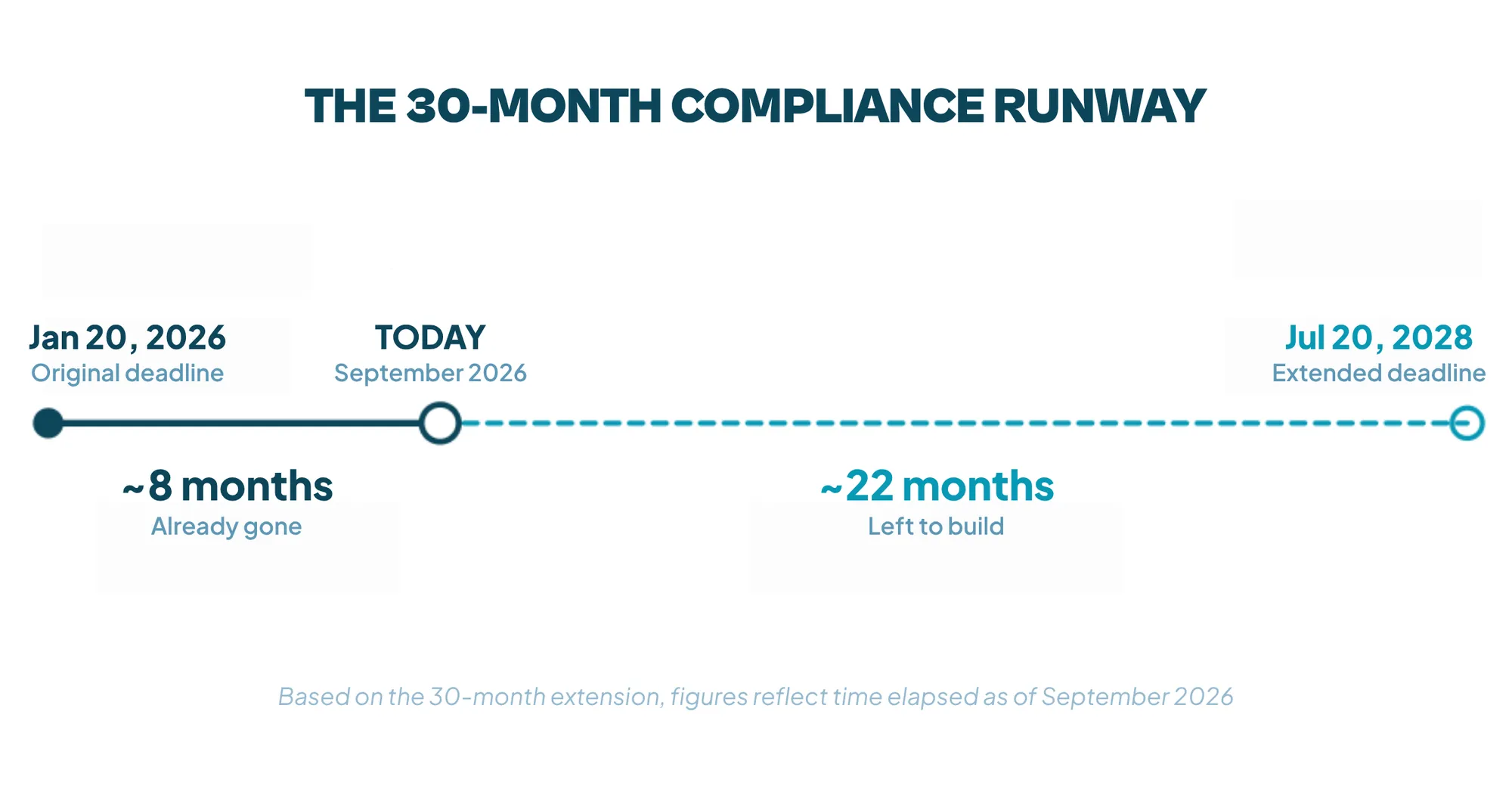
That outbreak landed in the same year the FDA pushed back the compliance deadline for the Food Traceability Rule under the Food Safety Modernization Act, FSMA Section 204, from January 20, 2026 to July 20, 2028, a 30-month extension. It would be easy to read that extension as room to breathe. The outbreak that broke out in the middle of it argues for the opposite conclusion.
FSMA 204 applies to foods on the FDA's Food Traceability List, a defined set of high-risk categories that includes many leafy greens, fresh-cut produce, certain cheeses, shell eggs, and several types of seafood, among others. For foods on that list, the rule requires operators across the supply chain to maintain, and be able to rapidly furnish, two categories of information: Key Data Elements (KDEs), the specific details captured at each point a covered food changes hands or form, and Critical Tracking Events (CTEs), the defined moments, harvesting, cooling, initial packing, receiving, transformation, shipping, where those details get recorded. Underlying both is the Traceability Lot Code, a single identifier meant to travel with a lot of product from harvest through to the plate, so that when a trace request comes in, the full chain of custody can be reconstructed instead of pieced together after the fact.
For a multi-location foodservice operator, that mostly plays out at the receiving and internal-transformation stages: capturing lot codes as covered foods come in, preserving that traceability when a lot is broken down, portioned, or recombined into a menu item, whether that happens in an individual kitchen or a commissary feeding many locations, as covered in more detail here, and being able to produce the full chain quickly if a trace request comes in.
The Federal Register notice extending the deadline is explicit that the underlying requirements aren't changing, only the timeline for having them fully in place. FDA's stated reasoning centered on the reality that the data these rules require often isn't routinely captured or shared today, that data systems across a fragmented supply chain frequently don't talk to each other, and that many distributors are still struggling to obtain lot codes from their own suppliers, let alone transmit them cost-effectively downstream. The technology needed to manage all of this at scale is, in the FDA's own framing, still being developed, piloted, and evaluated across the industry. A partial or phased rollout risked breaking the traceability chain at exactly the links where it's already weakest, so FDA opted for one unified extension instead.
That's a reasonable regulatory decision. It's also, unfortunately, a description of a genuine capability gap across the industry, not evidence that the underlying risk has gotten smaller while everyone catches up.
Here's what makes 2026 a strange year to treat 2028 as breathing room. While the compliance deadline moved out, federal food safety oversight capacity has been moving in the other direction. USDA's Food Safety and Inspection Service has more than 1,100 fewer roles than it had in 2024. FDA foreign food inspections fell from 805 in fiscal 2024 to 723 in fiscal 2025, and only 214 were completed in the first two quarters of fiscal 2026, at a time when imported foods already make up roughly 20% of the U.S. food supply. CDC's FoodNet surveillance system, which tracks infection rates for major foodborne pathogens including cyclospora, was scaled back in August 2025. Rutgers food science chair Don Schaffner's assessment of the combined effect was direct: reduced surveillance means a meaningful share of illnesses and outbreaks already go undetected, and these cuts are only going to make that worse.
None of this is presented to assign blame for a single outbreak. It's presented because it changes the actual risk calculus for any multi-location operator deciding how urgently to build FSMA 204 readiness. A regulatory deadline is one kind of pressure. The government's own capacity to catch a contamination event early, investigate it quickly, and warn the industry before it reaches national scale is a separate and arguably more important kind of protection, and that protection is what's visibly eroding in exactly the same window the compliance clock got reset.
The outbreak itself offered a real-world comparison of what traceability capability, or the lack of it, actually does during an active event. During a separate, unrelated Salmonella outbreak traced to contaminated jalapeños this same summer, Chipotle's RFID-based traceability system, built and deployed nationally well ahead of any regulatory requirement, let the chain identify the specific contaminated lot within hours of notification and coordinate quickly with health authorities to pull it. That's traceability functioning as it's supposed to: fast, precise, and capable of narrowing a problem down to a specific shipment rather than an entire product category.
The broader Cyclospora outbreak illustrated the opposite dynamic. Highly consolidated produce distribution, where a single supplier like Taylor Farms feeds a large share of the market, means a single contamination point can seed a genuinely national outbreak before anyone downstream has enough information to isolate and contain it. For a closer look at what that meant for operators in the moment, including the six specific actions the outbreak called for, see Cyclospora and Iceberg Lettuce: What Operators Should Take From This Outbreak. The lesson here isn't really about lettuce specifically. Traceability capability, or its absence, determines whether an operator can move fast and precisely when something goes wrong, or gets swept into a slow, broad, reputation-damaging response because nobody could isolate the actual scope of the problem in time.
Put those two threads together and the strategic picture is clearer than the deadline extension alone suggests. Federal enforcement capacity to catch a problem early is shrinking. The consequences of a slow, imprecise response, in outbreak scale, in brand damage, in the breadth of a recall or hold an operator has to issue without better information, are exactly the same regardless of what the compliance calendar says. The operators who already had traceability capability in place during this outbreak had a materially different experience than the ones who didn't.
The 2028 deadline is a compliance milestone, not a safety one. Waiting until the deadline approaches to start building traceability capability means voluntarily operating for two more years with less visibility into your own supply chain, during a period when federal visibility is also declining, purely because the paperwork requirement hasn't kicked in yet.
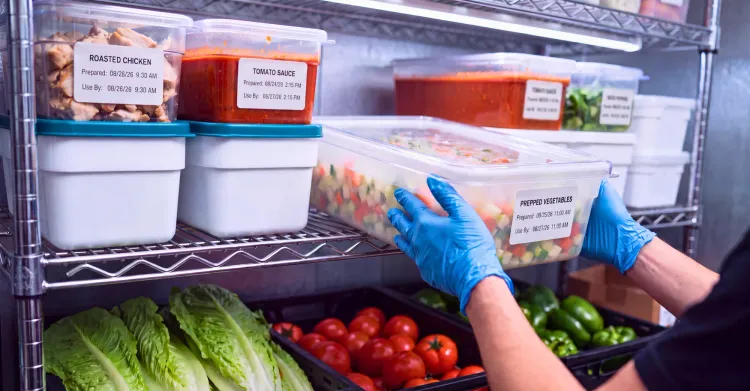
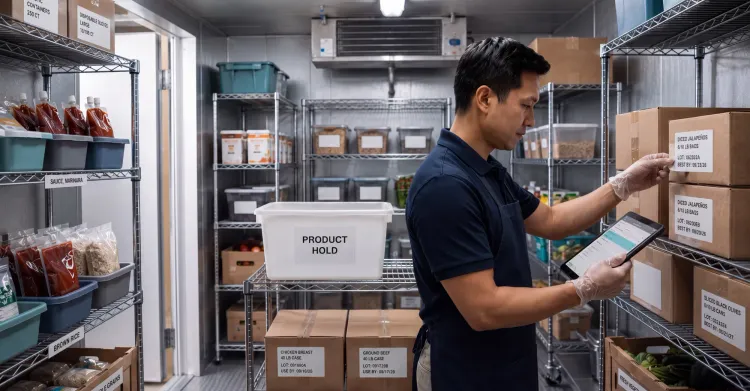
The practical starting point looks a lot like the traceability foundation any commissary or multi-location food safety program needs regardless of FSMA 204 specifically: lot-level labeling that travels with product from receiving through transformation into a menu item, temperature and handling records tied to the same batch, and a distribution record connecting what was produced to where it went. BOHA! Labeling, tied to lot and production data, gives an operator the core piece of that chain without requiring an entirely new system built from scratch ahead of a mandate that's still two years out.
The goal for 2026 is closing the gap between what a trace request would ask for and what your current systems can actually produce, not full FSMA 204 compliance ahead of schedule, so that whenever the next contamination event happens, wherever it originates in the supply chain, your own visibility into it doesn't depend on how far along the industry's slowest-moving distributor happens to be.
FSMA 204, the FDA's Food Traceability Rule under the Food Safety Modernization Act, requires enhanced recordkeeping for foods on the FDA's Food Traceability List as they move through the supply chain. The original compliance date of January 20, 2026 was extended by 30 months to July 20, 2028; the underlying requirements themselves were not changed.
No. The FDA has stated explicitly that the extension applies only to the compliance timeline, not the substance of the rule. Key Data Elements, Critical Tracking Events, and Traceability Lot Code requirements remain exactly as finalized.
The rule applies to foods on the FDA's Food Traceability List, which includes many leafy greens, fresh-cut produce, certain cheeses, shell eggs, and several seafood categories, among others. Operators should check the current list directly, since covered categories can be updated.
Reduced federal inspection and surveillance capacity means outbreaks and contamination events may take longer to detect and investigate, potentially allowing a problem to spread further before it's identified. An operator's own traceability capability becomes a more important safeguard when federal detection capacity is reduced.
No. The compliance deadline is a regulatory milestone, not a recommended starting point. Building lot-level labeling, connected temperature records, and distribution tracking now closes the visibility gap immediately rather than in 2028, and positions an operator ahead of the deadline rather than racing to meet it.
Get the latest industry insights delivered straight to your inbox
Browse