Stay in the loop!
Get the latest industry insights delivered straight to your inbox
Sushi rice sitting out at room temperature can be perfectly safe. The pH science behind why, and the testing, logs, and labeling that prove it to an inspector every time, whether you're running one sushi case or two hundred.
TransAct Technologies
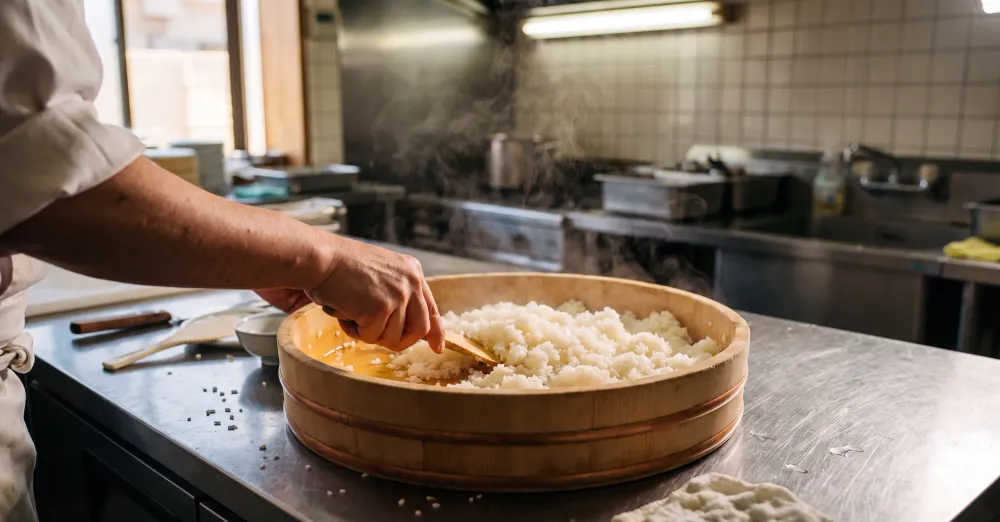
The nigiri in a grocery store's grab-and-go case has been out of the refrigerator for hours. An inspector who understands sushi rice chemistry walks right past it.
That's not a loophole. Sushi rice can legitimately sit outside the temperature danger zone because of what's actually in it: rice vinegar, sugar, and salt, mixed into the rice while it's still warm, dropping its pH low enough that the bacteria which normally thrive in that range can't get a foothold. Cold holding isn't the only way to control a hazard. Acidity does the same job, and once you've read what makes a step a critical control point, acidifying sushi rice is the clearest real-world example of it: a measurable limit, a way to monitor it, and no second chance if you get it wrong.
Get it wrong, though, and the story flips. Rice that isn't acidified enough is still a TCS food, sitting in the temperature danger zone with nothing protecting it. The difference between those two outcomes is a number on a pH meter, and whether you can prove it.
Bacillus cereus is the specific concern with rice, well documented enough that CDC calls the illness pattern “fried rice syndrome.” It's a spore-forming bacteria that survives cooking, and if cooked rice cools slowly or sits in the danger zone, those spores germinate and multiply. Refrigeration controls it by slowing growth down. Acid controls it differently, by making the environment itself hostile enough that growth can't get started in the first place.
pH measures how acidic or alkaline something is, on a scale where 7 is neutral, lower numbers are more acidic, and each whole number is a tenfold jump in acidity from the one above it. Plain cooked rice sits close to neutral, comfortably hospitable to bacteria. Vinegar is acidic enough to pull it well down the scale, if there's enough of it mixed in evenly and it's measured, not assumed.

Most sushi-specific health department guidance puts the target at pH 4.2 or below, tighter than the pH 4.6 threshold used for acidified foods more broadly, because rice doesn't carry the same built-in safety margin as a truly shelf-stable acidified product. A Kentucky health department guideline on sushi rice acidification states the requirement plainly: reducing the rice to below pH 4.2 is what makes it safe to hold at room temperature. That said, your own health department sets the number that actually governs you, since the FDA Food Code is a model code, not a single national rule, and states and counties adapt it, sometimes with a stricter or looser local number for exactly this reason.
Reaching that number isn't a matter of “enough vinegar, by feel.” It takes a validated recipe (a fixed rice-to-vinegar-to-water ratio your health department has already accepted or one you've tested yourself) and it takes measuring every batch, not the first one of the day. A calibrated pH meter is the standard; pH test strips are commonly accepted too, provided their margin of error, typically ±0.2 to 0.3, is small enough to still land you safely under the target once you account for it.
A common starting ratio is roughly 3 tablespoons of seasoned rice vinegar per 2 cups of uncooked rice, folded in while the rice is still warm. Treat that as a starting point, not a number to copy and trust. Two kitchens using the identical ratio can land at different final pH depending on the rice variety and how evenly the vinegar got folded through the batch, which is why the meter reading is what counts on your log, not the recipe card.
None of this is a single restaurant's improvisation, either. The current sushi rice criteria trace back to Conference for Food Protection Issue 2023-III-008, the body that proposes updates to the model Food Code, which the FDA folded into Annex 6 of its 2022 Food Code supplement as a new acidification section, alongside a companion standardization guide the same conference issued (Issue 2023-III-006) for how regulators and sushi operations apply it consistently. States and counties still set their own exact numbers and paperwork, but the underlying science was vetted once, by a coordinated national process, not reinvented fifty separate times.
Not every kitchen needs the same paperwork, because not every kitchen is using acidification the same way. It usually comes down to one of three approaches:
| Approach | What it requires | Do you need a variance? |
|---|---|---|
| Acidify to hold at room temp, long-term (a self-serve case, a display) | Validated recipe, per-batch pH testing, calibration log, typically discarded within 24 hours | Usually yes, a HACCP plan and variance from your health department |
| Acidify for flavor only, still refrigerated | Standard TCS handling: cold hold at 41°F or below, used within about 7 days | Usually no, vinegar is seasoning here, not a control |
| No acidification claim, same-day service only | Time as a Public Health Control, marked and served or discarded within the window | Usually no, but a written procedure is required for the 6-hour option |
That middle row surprises people. If the vinegar is there for taste and the rice still goes back in the walk-in, you're not claiming a pH-based exemption at all, and you don't need one. The paperwork only shows up once you're asking the rice's chemistry to do refrigeration's job.
An inspector isn't going to take your word for the pH, and a health department reviewing a variance application isn't going to take your word for the calibration. Both need to see it, dated and specific:
That's what “audit-proof” actually means here. Not a sticker that looks official, a record that answers the exact question an inspector is going to ask before they ask it.
Most sushi rice problems that surface during an inspection or a variance application trace back to one of a handful of habits, not a single dramatic failure:
None of these are exotic. They're the ordinary way a documented process quietly drifts into an undocumented one, until an inspector asks for the log that was supposed to be there.
Acidification handles the rice. It doesn't handle the raw fish, the imitation crab, or anything else genuinely TCS sitting on top of it once the piece is assembled and displayed at room temperature for service. That's where Time as a Public Health Control (TPHC) usually comes in, and it comes with its own labeling rule, not a suggestion.
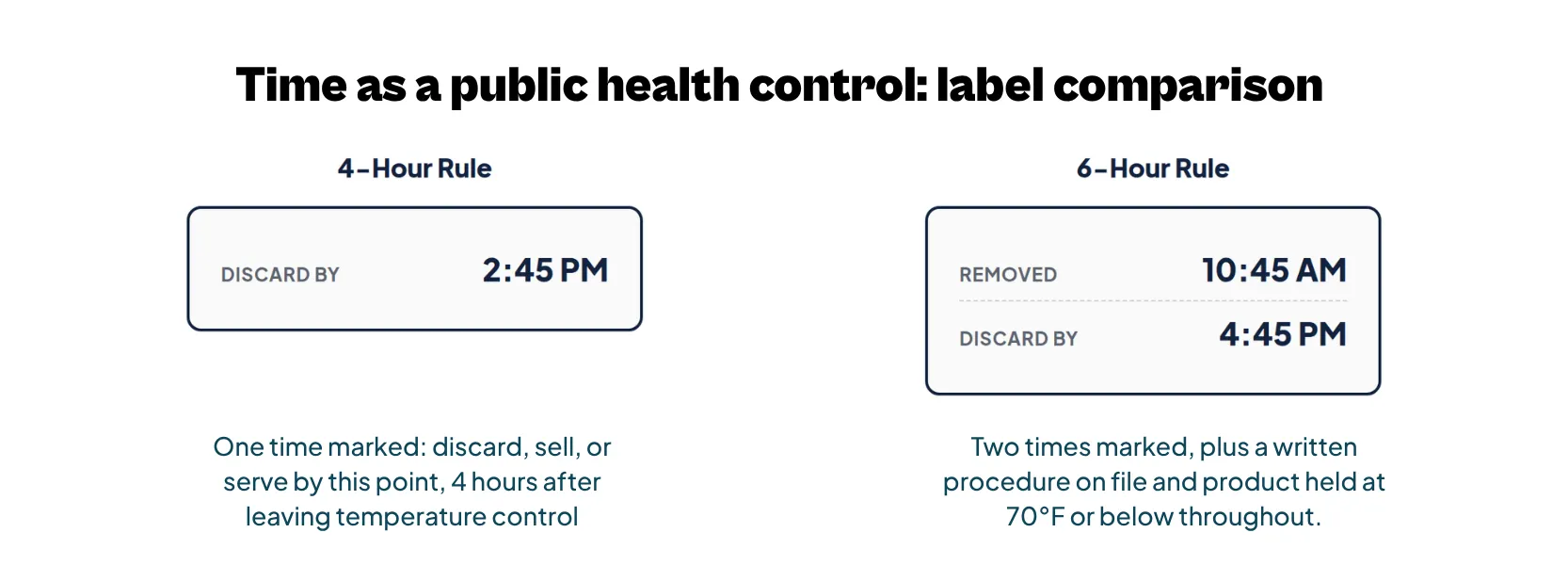
Under the 4-hour rule, the food is marked with the time it must be sold, served, or thrown out, exactly 4 hours after it left temperature control. Under the 6-hour rule, it's marked twice, the time it left cold holding and the time 6 hours later when it has to go, the product can't exceed 70°F for the whole window, and your operation needs a written procedure on file describing how you're meeting that. Neither rule cares what the label looks like. Both care that the time on it is accurate and that someone is actually checking it.
Plenty of grocery and c-store sushi programs vacuum-seal or use a modified-atmosphere tray to stretch shelf life on a grab-and-go case. That's reduced oxygen packaging, ROP, and it raises a hazard that has nothing to do with the rice's pH at all. Pulling the oxygen out of a package creates an environment where anaerobic pathogens, Clostridium botulinum foremost among them, can thrive if nothing else is controlling for it.
Under the Food Code, most ROP needs its own HACCP plan and variance, separate from anything the rice already required. There's one common exception: product that's dated with its packaging time, held at 41°F or below, and pulled from its package within 48 hours of packaging doesn't need a separate ROP variance. Extend the shelf life past that window, usually the whole reason a program adopts ROP, and the variance requirement comes back, stacked on top of whatever acidification paperwork the rice already needs. Two exemptions, two separate applications, and meeting one doesn't excuse you from the other.
None of this touches the fish sitting on top of the rice, and “sushi grade” isn't the reason it's safe to eat raw. There's no official grading system that puts that label on a piece of tuna or salmon. What actually matters is whether the fish went through parasite destruction: frozen at -4°F for 7 days, or at -31°F until solid plus 15 hours at -31°F, or at -31°F until solid plus 24 hours at -4°F, per FDA's own guidance for fish intended to be served raw or undercooked.
A supplier calling something “sushi grade” is a claim about handling and freshness, not a substitute for knowing whether that freezing step actually happened and can be documented. It's a separate hazard, controlled at a separate step in the process, which makes it a separate critical control point from the rice pH question this piece is built around, worth its own conversation with your supplier and your own paper trail, not an assumption baked into a label.
One location eyeballing the vinegar ratio and another one measuring it isn't a training gap, it's two different food safety outcomes wearing the same recipe card. The same is true of TPHC labels: a piece of tape with a handwritten time is compliant right up until it smudges, falls off, or nobody double-checks the math on a busy Saturday.
Digitizing the pH log, the calibration log, and the TPHC time stamps turns each of those into a record you can actually produce, batch by batch, location by location, instead of a claim you're hoping holds up. For an operator running sushi across a grocery chain, a hotel food and beverage program, or a casino floor, that consistency is what a real food safety and compliance program looks like at scale: the same standard, provably met, everywhere the product is served.
Sushi rice can safely sit outside the danger zone because acidifying it to a low enough pH, usually 4.2 or below by most sushi-specific guidance, does the same job refrigeration normally does. Getting there takes a validated recipe and a pH check on every batch, not a guess. What you actually need to keep, a variance or not, depends on whether you're claiming that exemption long-term, using the vinegar for flavor only, or working within same-day Time as a Public Health Control limits instead. Vacuum-sealing the finished product for a longer shelf life raises a separate packaging question, and the raw fish on top raises a separate one again. Whichever combination fits your operation, the paperwork isn't the obstacle. It's the proof.
Most sushi-specific health department guidance sets the target at pH 4.2 or below, stricter than the 4.6 threshold used for acidified foods generally. Your local health department sets the number that actually governs your operation.
Plain cooked rice is. Properly acidified sushi rice, tested and documented at or below your local target pH, is not, which is why it can be held outside strict temperature control.
Usually only if you're relying on acidification to hold the rice at room temperature long-term. If the vinegar is for flavor and the rice stays refrigerated, or if you're using Time as a Public Health Control for same-day service, most health departments don't require a variance.
A Food Code provision that lets a TCS food sit outside temperature control for a limited window, 4 or 6 hours, provided it's marked with the time it must be served or discarded and, for the 6-hour option, backed by a written procedure.
It depends which rule you're using. Properly acidified rice under an approved variance can be held well beyond a few hours. Rice or finished sushi under Time as a Public Health Control is limited to 4 or 6 hours, marked and tracked from the moment it leaves temperature control.
It's the specific spore-forming bacteria that survives cooking and can multiply if rice cools too slowly or sits in the temperature danger zone, which is the hazard both proper cooling and acidification exist to control.
Only if it's held longer than 48 hours after packaging. Inside that window, dated with the packaging time and held at 41°F or below, most health departments don't require a separate reduced oxygen packaging variance.
No official grading system exists. What's legally required is that fish intended to be served raw went through the Food Code's parasite destruction freezing process, which is a supplier and documentation question, not a label.
Get the latest industry insights delivered straight to your inbox
Browse