Stay in the loop!
Get the latest industry insights delivered straight to your inbox
A CCP is the step in your process where a hazard can be prevented, eliminated, or reduced to a safe level, and where losing control can make the food unsafe to serve. How to identify yours and tell them apart from the many steps that merely matter.
Dana Loof
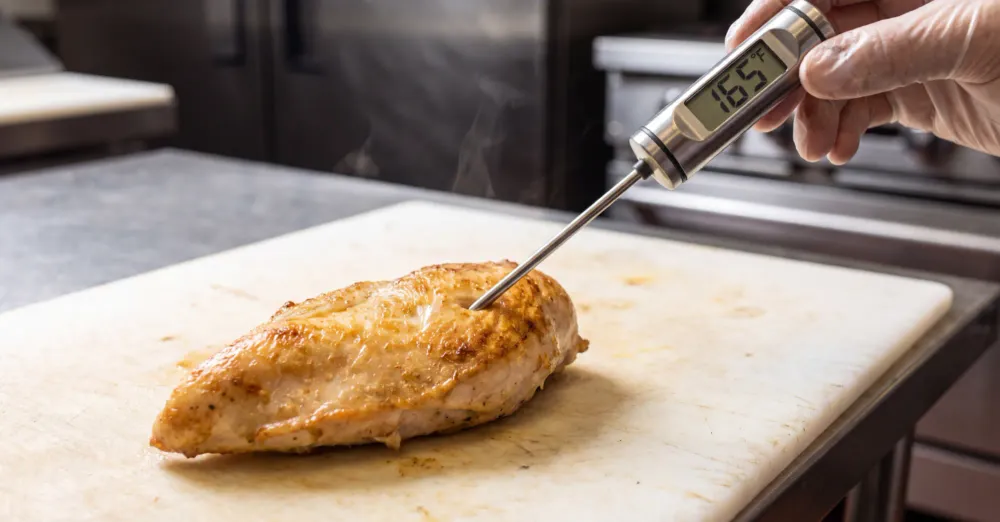
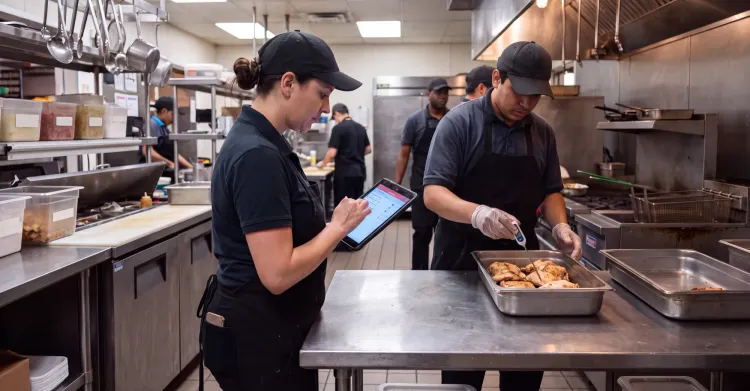
Cooking a chicken breast to 165°F can be a critical control point. Wiping down the prep table usually is not. Both are important. The difference is that one may be a step where getting the control right is essential to keeping food safe. Knowing which is which is the entire point of the concept.
A critical control point, usually shortened to CCP, is a step in your process where you can prevent, eliminate, or reduce a food safety hazard to a safe level, and where control at that step is essential. That is what separates a CCP from a good practice. Whether a later step can control the same hazard is part of the hazard analysis that determines whether the step is truly critical.
CCPs are the heart of a HACCP plan. The whole framework is built around finding them. You analyze your process for hazards, biological, chemical, and physical, you identify the points where those hazards can actually be controlled, and everything after that, the limits, the monitoring, the corrective actions, exists to keep those specific points under control.
The concept is not hypothetical. USDA requires a validated HACCP system in every meat and poultry plant it inspects. In restaurants and contract foodservice, FDA's Food Code uses the same risk-based logic, although a formal HACCP plan is required only for certain processes, variances, and other situations defined by the regulator.
Cooking, cooling, hot-holding, and certain acidification steps are the usual suspects, because each can be a moment where a food safety hazard has to be controlled. Miss the cook temperature on a chicken breast and no amount of careful labeling downstream makes it safe to serve. You need corrective action. Miss the two-stage cooling window on a stockpot and the same is true. That's why these steps so often show up as critical control points rather than merely important steps.

You don't need a consultant to find most of your CCPs. To find them easily, you need to walk through your process and ask, at each step, four things:
Those answers help narrow down where your CCPs are, and your hazard analysis makes the final call. When the answer to all four is yes, you are standing at a critical control point.
That fourth question is the one operators skip, and it is the one that matters most in a multi-location operation. A CCP you cannot monitor consistently is a CCP you cannot prove you controlled, and in food safety, unproven is functionally the same as uncontrolled, especially once an inspector or a corporate auditor is asking to see the record instead of taking your word for it.
Every operation's hazard analysis is its own, but in practice, most foodservice CCPs cluster around the same handful of process steps. Here is what that looks like in plain terms:
| Process step | What can go wrong | Critical limit | How it's typically monitored |
|---|---|---|---|
| Receiving | TCS foods arrive already in the danger zone | Generally at or below 41°F for refrigerated TCS foods at delivery | Temp check at the dock, logged before product moves to storage |
| Cooking | Raw product doesn't reach a temperature that actually kills the hazard | Varies by food and applicable requirements (165°F for poultry, 145°F for whole cuts) | Probe thermometer at the end of cook, recorded digitally |
| Cooling | Cooked food lingers in the danger zone on its way back down | 135°F to 70°F within 2 hours, then 70°F to 41°F within 4 more | Staged product temp checks, often backed by a continuous sensor, and logged with timestamps |
| Hot-holding | Held food drifts below a safe holding temperature over a shift | At or above 135°F | Continuous sensor or scheduled manual checks |
| Acidifying | A shelf-stable product isn't acidic enough to be safe outside refrigeration | pH at or below 4.6 | pH meter or test strips, recorded per batch |
The "how it's monitored" column is usually where operations lose the thread, not the limits themselves. Everyone running a kitchen knows chicken needs to hit 165°F. Fewer can show, for every batch, at every location, that it did.
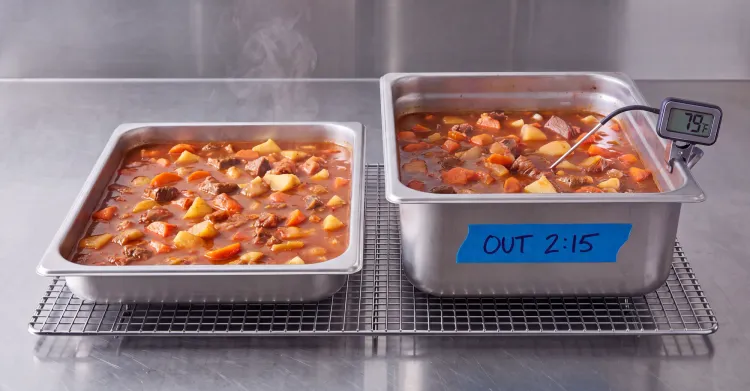
Take cooling, since it gets a fraction of the attention the cook step does. A five-gallon pot of chili coming off the line at 135°F has two hours to reach 70°F and four more to reach 41°F, the same two-stage window covered in the temperature danger zone. Run it through the four questions above: the hazard is real (bacteria multiply fastest in exactly this range), the cooling step is what controls it, a missed limit requires corrective action - nothing downstream corrects a stalled pot, and the window is easy to measure with a thermometer and a clock. That makes cooling just as critical as the cook step, even though nobody stands over a cooling pot the way they stand over a grill.
Identifying a CCP is step one. Watching it is the job.
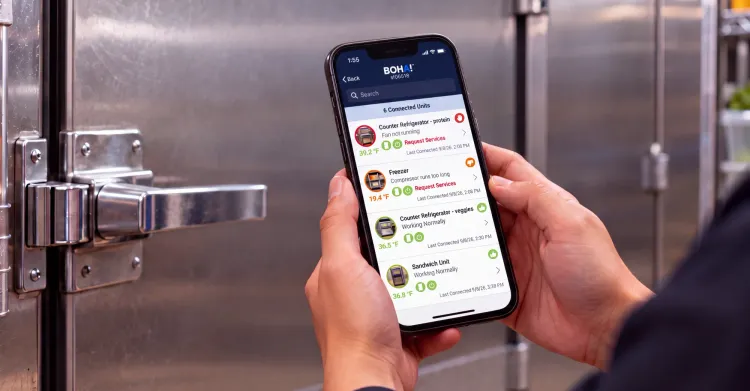
Every CCP needs a critical limit (the cook temperature, the cooling time, the pH), a way to monitor it, and a corrective action for when it drifts out of range. In a modern kitchen, that monitoring is increasingly digital. A temperature check captured in a digital record at the cook step, a continuous sensor watching whether the cooler stays in range, and a checklist confirming the hot-hold. Together, those records turn a critical control point from something you hope was handled into something you can show was handled, batch by batch, with a timestamp attached.
For an operator running dozens or hundreds of locations, that digital record is also what makes it possible to standardize one HACCP plan across every site and still prove, location by location, that the same critical control points are actually being monitored the same way, rather than trusting that each site is interpreting the plan correctly on its own. That is what a real food safety and compliance program looks like at scale, not just paperwork that satisfies an audit.
A critical control point is a step where control is essential to prevent, eliminate, or reduce a food safety hazard to a safe level. Find yours by walking your process and asking whether the hazard is real, whether the step controls it, whether another step later will, and whether you can monitor it. Then set the limit, define the corrective action, and keep the record. If you haven't mapped this against your own kitchen yet, How to Build a HACCP Plan for Restaurants walks through it end to end. Do that, and HACCP stops being a binder on a shelf and becomes the thing that actually keeps your food safe, at one location or a thousand.
The step in a food process where a hazard can be prevented, eliminated, or reduced to a safe level, and where losing control means the food cannot be made safe by any later step.
Critical control point. It's a term inside the larger HACCP (Hazard Analysis and Critical Control Point) system, not a synonym for it.
A control point is any step where safety is managed. A critical control point is one where a failure cannot be corrected downstream.
Cooking, cooling, hot-holding, receiving, and certain acidification steps are the CCPs most operations share, though the exact list always comes from your own hazard analysis rather than a generic template.
Cooking to a required temperature, cooling within time limits, hot-holding, and certain acidification steps.
HACCP is the full food safety system CCPs belong to: the hazard analysis identifies where things can go wrong, and the critical control points are the specific steps chosen to control them.
Set a critical limit, monitor it (often digitally), and define a corrective action for when it drifts out of range.
Get the latest industry insights delivered straight to your inbox
Browse