Stay in the loop!
Get the latest industry insights delivered straight to your inbox
A supplier substitution or a reformulated sauce sounds like a small change. On the label side, it's an allergen risk waiting to happen. Here's how recipe change management keeps every location's labels accurate the moment an ingredient changes.
TransAct Technologies
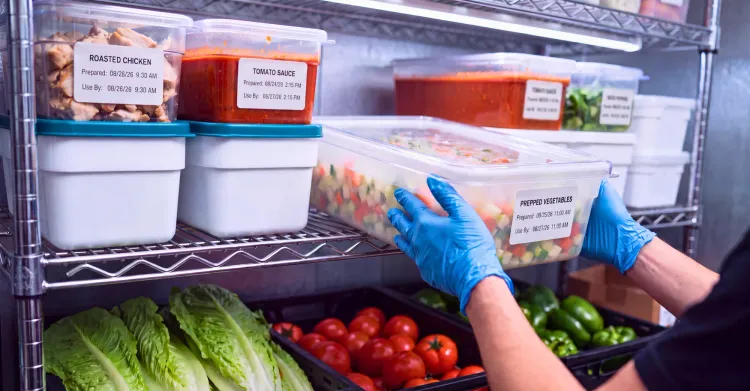
A regional distributor runs out of the usual soybean-based base for a signature sauce and substitutes a sesame-based alternative for three weeks. Purchasing signs off because the substitute meets spec and the invoice looks routine. Culinary updates the recipe card at headquarters. A note goes into the shared drive, an email goes to regional managers, and the assumption is that the change will reach the line the same way every other update has: eventually, and probably intact.
Here's what actually happens in a lot of multi-location kitchens. The corporate recipe card gets updated. The label template sitting in the point-of-sale system, or in a standalone labeling app at the store level, does not. Nobody owns the step that connects the two. The label a customer reads on Thursday still lists the old ingredient set, because the person who builds and prints that label at 6 a.m. is working from whatever template loaded last, not from whatever changed in a recipe database three states away.
This is the part of food safety that doesn't get talked about as much as temperature logs or hand-washing signage, and it should. A recipe change is not just a culinary decision. The instant an ingredient, supplier, or formulation shifts, it's a labeling event and, quite often, an allergen disclosure event. Whether that event closes cleanly or leaves a gap between what's cooking and what's printed depends entirely on whether the operation has a real process for propagating the change. Announcing it is not the same thing as delivering it.
Recipe change management is the operational discipline of making sure that every ingredient, supplier, or formulation change gets checked against allergen and labeling requirements and reflected on every affected label before it reaches a guest. It's a discipline worth building deliberately, because multi-location foodservice operators don't run static menus. Supplier substitutions happen because of weather, freight disruptions, or a vendor's own reformulation.
Culinary teams adjust recipes for cost, for regional taste preferences, for seasonal menu refreshes, and increasingly for ingredient sourcing volatility that has become close to a permanent condition in the supply chain. The Food Institute's November 2025 analysis of operator sentiment found that 76% of restaurant operators say rising ingredient costs are cutting into profits, and a quarter point to supply chain volatility itself as a top obstacle heading into 2026. That pressure is exactly why chains lean on the kind of continuous menu and sourcing adjustments the National Restaurant Association's 2026 Culinary Forecast tracks as ongoing trends, from cleaner recipes with fewer additives to a shift toward local sourcing, not changes chains make once a year and leave alone.
Most food safety programs, though, are built around a different rhythm: the annual menu refresh, the quarterly audit, the yearly HACCP plan review. A supplier substitution that lasts three weeks, or a small tweak to a marinade to hit a food cost target, rarely triggers the same level of scrutiny as a full menu launch. It's treated as operational noise rather than as what it actually is: a change to the product a guest is eating, and potentially a change to what needs to be disclosed on the label that comes with it.
That mismatch between how often recipes actually change and how rarely the compliance process notices is where labeling risk accumulates. Not in one dramatic failure, but in a slow drift between what's in the pan and what's on the label.
It's tempting to think of allergen accuracy as a fixed list you get right once and maintain. In reality, the allergen profile of a dish is only as current as the last ingredient swap. Recipe change management and allergen management are, functionally, the same discipline wearing two different names.
The regulatory landscape has already delivered a clear example of how fast an ingredient assumption can become a compliance gap. The Food Allergy Safety, Treatment, Education, and Research (FASTER) Act, signed into law in April 2021, designated sesame as the ninth major food allergen recognized under U.S. law, joining milk, eggs, fish, crustacean shellfish, tree nuts, peanuts, wheat, and soybeans. The requirement took full effect on January 1, 2023, per FDA guidance, meaning any product formulation containing sesame needed to disclose it clearly.
Operators who had sesame buried in a spice blend, a bun glaze, or a sauce base as a minor formulation detail suddenly needed that ingredient surfaced on every label touching that item, at every location, on a fixed effective date. That transition is a useful stress test in hindsight: any operation whose recipe database and label templates weren't tightly connected had to do that reconciliation manually, item by item, location by location. The operations that struggled with the sesame transition are the same ones that will struggle every time a supplier substitutes an ingredient that happens to introduce or remove a major allergen. Unlike a regulatory deadline, though, a supplier substitution rarely comes with six months of advance notice.
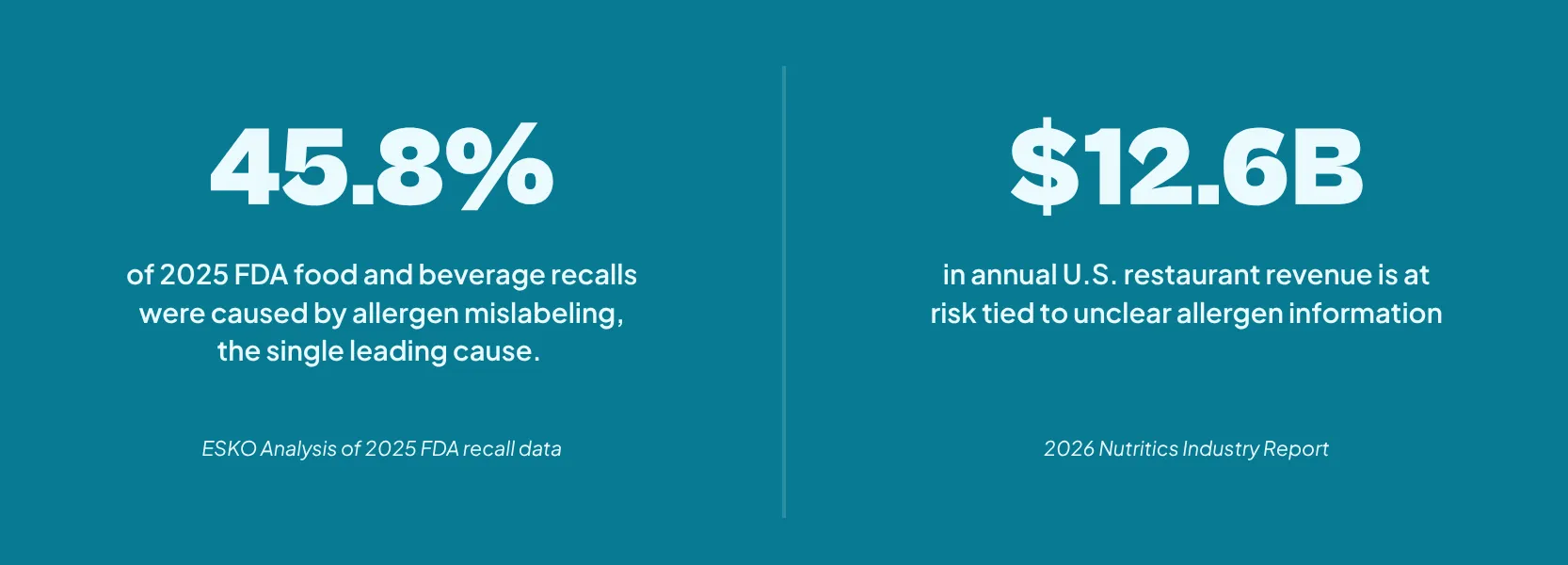
The scale of this risk isn't theoretical. An analysis of 2025 FDA recall activity found that 251 food and beverage recall events were issued over the year, and allergen mislabeling was the single leading cause, responsible for 115 of them, or 45.8% of all recalls, ahead of foodborne illness at 37.5%. On the USDA side, a review of FSIS recall data for 2025 found undeclared allergens as the second-leading cause of meat and poultry recalls that year, trailing only foreign material contamination.
Notice what both data sets have in common: these aren't recalls triggered by contamination in the traditional sense. They're recalls triggered by a gap between what a product actually contains and what its label says it contains. That's precisely the failure mode that opens up whenever a recipe changes and the label doesn't change with it.
The commercial exposure runs alongside the regulatory exposure. A 2026 industry report from Nutritics estimated $12.6 billion in annual U.S. restaurant revenue at risk tied to unclear allergen information, based on a survey where 95% of allergy-affected diners said they've walked away from a restaurant over insufficient allergen clarity. The same report found that 57% of respondents named one factor above all others as the thing that would rebuild their trust: allergens clearly marked on every menu item, every time. That's not a food safety statistic. That's a demand-side signal that accurate, current labeling is a revenue lever, not just a compliance checkbox.
In a manual or decentralized labeling setup, a recipe change has to survive several handoffs before it reaches a printed label, and each handoff is a place where it can quietly stall.
The recipe lives in one place and the label template lives in another. Culinary teams typically manage recipes in a recipe database, a shared spreadsheet, or a static PDF that gets emailed out, rather than in recipe management software connected to how labels actually get built. Labels get built separately, often in whatever tool sits closest to the printer at each location. Unless someone manually rebuilds every affected label template after every recipe change, the two systems simply don't talk to each other.
Rollout depends on someone noticing. A corporate recipe update is only as good as the manager at each of fifty, two hundred, or a thousand locations who reads the memo, understands which items it touches, and manually edits the local label template before the next print run. Field teams are already managing labor, inventory, and service. A label template update competes with a dozen more urgent tasks on any given shift, and it's the kind of task that has no visible consequence until an inspector, or a guest with an allergy, finds the gap.
There's no single source of truth to audit against. When a health inspector or an internal auditor asks "how do you know every label reflects the current recipe," a decentralized operation often can't answer with anything more concrete than "we sent an email." There's no record of which locations updated their templates, which are still running the old version, or when the change actually took effect on the floor. That absence of an audit trail is itself a finding waiting to happen, independent of whether any single label is currently wrong.
Individually, none of these gaps looks dramatic. Together, they explain why a change that took five minutes at headquarters can take weeks to fully reach the floor, if it ever fully does.
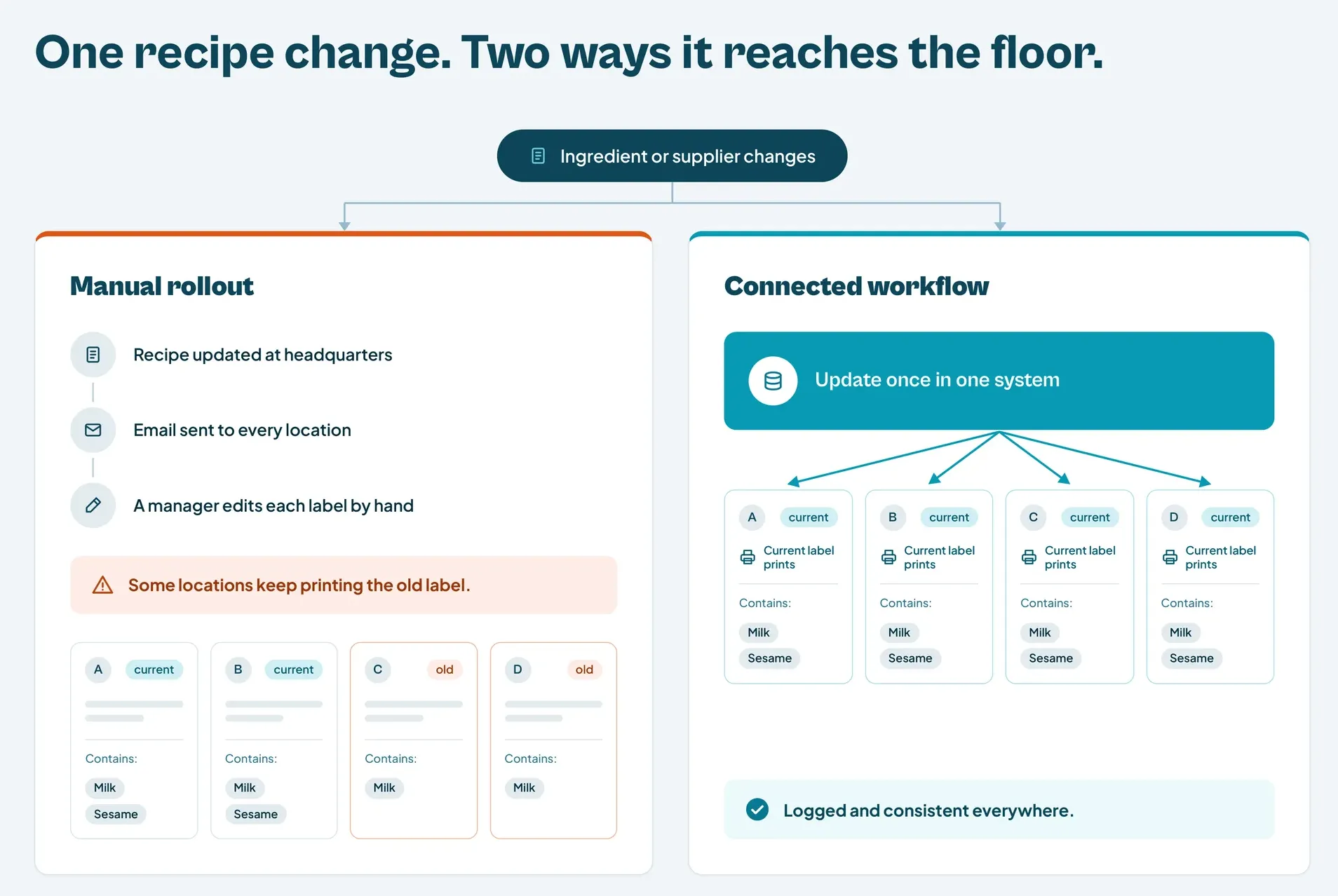
The fix isn't a stricter memo. It's removing the manual handoff between "recipe changed" and "label updated" entirely, so the two are structurally the same event rather than two separate tasks performed by two different people on two different timelines.
That's the operating principle behind pairing BOHA! Food Prep with BOHA! Labeling as part of a connected Food Prep & Labeling workflow. Recipes, prep guides, and ingredient data live as a single source that label generation pulls from directly, rather than as a document that someone has to manually translate into a separate label template. When an ingredient, allergen note, or portion changes at the source, downstream labels tied to that item are built to reflect it the next time they print. The goal, either way, is that nobody has to remember to make the edit by hand at the location level.
That same connection is what gives headquarters visibility instead of assumption. Through the BOHA! Control Center, corporate and regional teams can see labeling activity across locations, rather than relying on field reports of whether an update they sent actually took hold. Even without getting into every reporting detail, the operating shift is the important part: a recipe change stops being an announcement that people are trusted to act on, and becomes a data change that the labeling system enforces automatically.
This is also where interoperability earns its keep in practice, not just on a spec sheet. A connected recipe-to-label workflow is only as strong as its weakest integration point: when inventory, POS, and prep systems don't share data cleanly, a recipe update can still get lost between systems even with good labeling software in place. That's the case for treating recipe change management as a platform decision, not a single-app fix.
Technology closes the gap, but the underlying discipline applies regardless of what system an operation is running today. A recipe change management process worth trusting needs a few things in place:
For operators who want a structured starting point, we've put together a Recipe Change Management Workflow guide that walks through exactly this process, from the moment an ingredient or supplier changes through confirming every affected label is current across every location.
[Download: Recipe Change Management Workflow]
Getting the label right at the moment of prep is its own discipline worth reinforcing alongside this one. For a closer look at how that plays out for customized, made-to-order items specifically, see Made-to-Order Labeling: Speed, Accuracy, and One Barcode. And if the deeper question is why labeling systems that work fine at five locations start failing at fifty, that's covered in Why Fresh Food Labeling Systems Break Down at Scale and Cheap Food Prep Labels Become Expensive: The Hidden Costs No One Talks About.
Most operators can answer "do we have an allergen policy." Fewer can answer a harder, more current question: if a supplier substitutes an ingredient tomorrow morning, how long before every affected label at every location reflects that change, and how would you prove it if an inspector asked? If the honest answer involves an email chain and some hope, that's not a labeling gap. It's a recipe change management gap, and it's fixable well before it turns into a recall, a health department finding, or a guest reaction that never should have happened.
Not quite, though they overlap heavily. An allergen policy defines what needs to be disclosed and how. Recipe change management is the operational process that makes sure any new ingredient, supplier substitution, or formulation change actually gets checked against that policy and reflected on every label before it reaches a guest. One is the rulebook; the other is what keeps the rulebook accurate in real time.
It works best as a shared accountability between culinary or R&D, who initiate recipe changes, and operations or food safety leadership, who confirm the change has propagated to labels at every location. The failure point in most operations isn't a lack of policy. It's the absence of one clear owner for the handoff between "recipe changed" and "label updated."
Not automatically, but every substitution should trigger a quick check. A swap that doesn't touch an allergen, a nutrition claim, or a material ingredient listed on the label may not require a reprint. A swap that does, even a temporary one during a supply disruption, needs the label updated for as long as that substitute ingredient is in use, not just at the next scheduled menu refresh.
The FASTER Act is a clear example of how an ingredient that seems minor, like sesame in a spice blend or coating, can become a mandatory disclosure with a hard compliance deadline. The same logic applies any time a supplier substitution quietly introduces one of the nine major allergens into a recipe that didn't previously contain it. A strong recipe change process catches that the moment the substitution happens, not months later.
Pick one item that's had a recent supplier substitution or recipe tweak, and check whether the printed label at three or four different locations matches the current recipe exactly, including allergen notes. If even one location is running an outdated template, that's a signal the propagation process, not any single employee, needs attention.
It depends on how connected the underlying systems are. A recipe-to-label workflow is most reliable when recipe data, prep tracking, and label generation share a common source rather than living in separate, disconnected tools. Strong interoperability between POS, inventory, and labeling systems is what keeps a recipe change from getting lost in translation between platforms.
By treating it as a data problem instead of a communication problem. A memo or shared spreadsheet works until the location that skips it is the one an inspector or a guest with an allergy happens to visit. Operations that keep allergen information consistent across dozens or hundreds of locations do it by connecting the recipe and the label to one shared source, so a change made once at headquarters is the same change every location prints from, rather than a separate task each location has to remember and complete correctly on its own.
Get the latest industry insights delivered straight to your inbox
Browse