Manual food labeling and the compliance cliff: what the NY allergen law exposes about your current process
NY's allergen law goes live November 2026, and it doesn't care that your process was good enough before. Here's where manual labeling actually breaks — and what to fix before an inspector finds it first.
Dana Loof
The law does not grade on a curve
Every multi-location operator has lived some version of this story. A label goes out with a hold time that's three weeks out of date, because the template on the store tablet hasn't caught up with the one at headquarters. Nobody gets sick. Nobody even notices, most of the time. The shift moves on, the case gets stocked, and the small inconsistency joins a few hundred others just like it, quietly compounding across the year.
That's always been true of manual labeling, and for a long time the only people paying for it were the operators themselves — in rework, in wasted product, in the low hum of friction that comes from a process held together by good habits instead of a system.
New York's allergen labeling law changes who picks up that tab. Signed by Governor Hochul in November 2025 and taking effect November 12, 2026, §199-G of the Agriculture and Markets Law requires every food establishment in the state to label prepackaged food with written allergen notification before it ever reaches the case. The statute doesn't ask how the label went wrong. It doesn't care that your corporate template used to be accurate, or that your training program is genuinely good, or that the person who mislabeled the sandwich has done this job for eleven years without an incident. A label that's missing an allergen is a label that's missing an allergen, whatever the reason.
That's the cliff. The inconsistency was always there. What changes on November 12 is who's standing at the bottom of it.
What §199-G actually asks you to do
Before getting into where this goes wrong, it's worth being exact about what the law covers, because the scope trips people up in both directions.
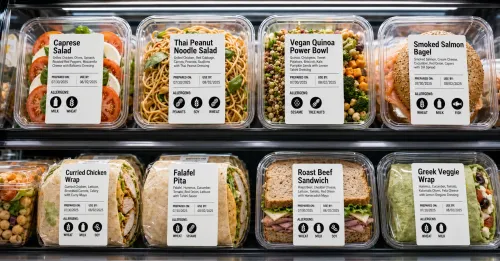
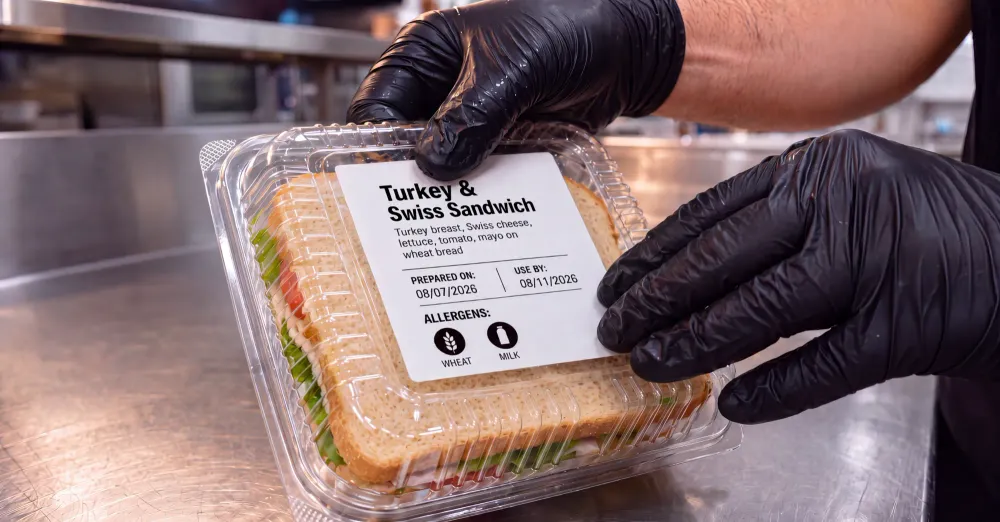
It applies to food establishments — delis, bakeries, sandwich shops, food trucks, cafeterias — where food is prepared, packed, and sold on the same premises. If a customer orders a sandwich and someone builds and wraps it on the spot, that's outside the law. If the sandwich is already built, wrapped, and sitting in the case when the customer picks it up, that's exactly what the law is written for.
Here's the part that catches multi-location operators off guard: it doesn't require a full ingredient list. Just the major allergens — milk, eggs, fish, crustacean shellfish, tree nuts, peanuts, wheat, soy, and sesame, which joined the list as the ninth major allergen under the FASTER Act back in January 2023. That sounds simple enough for one sandwich. It stops sounding simple the moment you multiply it across every rotating SKU, every location, every time a recipe or a supplier changes.
Health departments will be the ones checking. They already inspect these establishments routinely, so allergen labeling just becomes one more line on a checklist they're already running — and unlike a lot of operational findings, a missing allergen declaration isn't the kind of thing an inspector waves off.
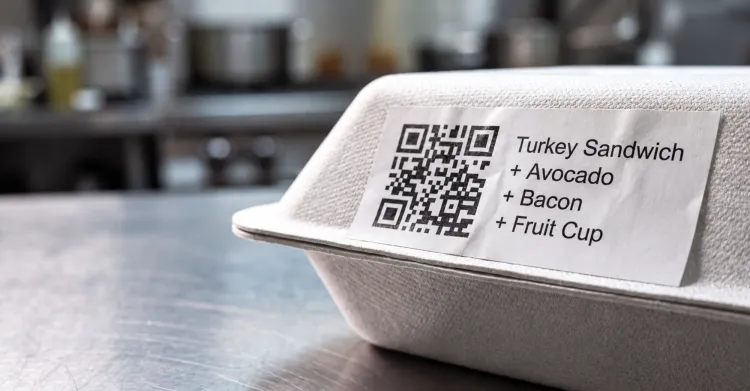
Every prepackaged item on your line needs an allergen-accurate label, updated the moment anything changes, at every location. That's not a printing problem. That's a data problem wearing a printing problem's clothes.
Manual labeling was never built to survive contact with a statute
Here's the honest version of how manual labeling actually works: it works because people are good at their jobs. A veteran prep cook knows the real hold time even when the template still shows the old one. A sharp manager catches the wrong date before the tray hits the case. Teams that have been doing this for years develop an instinct for where the gaps usually are, and they cover for them without even thinking about it.
That instinct is real, and it's worth something. It's also exactly the thing a legal compliance standard can't be built on.
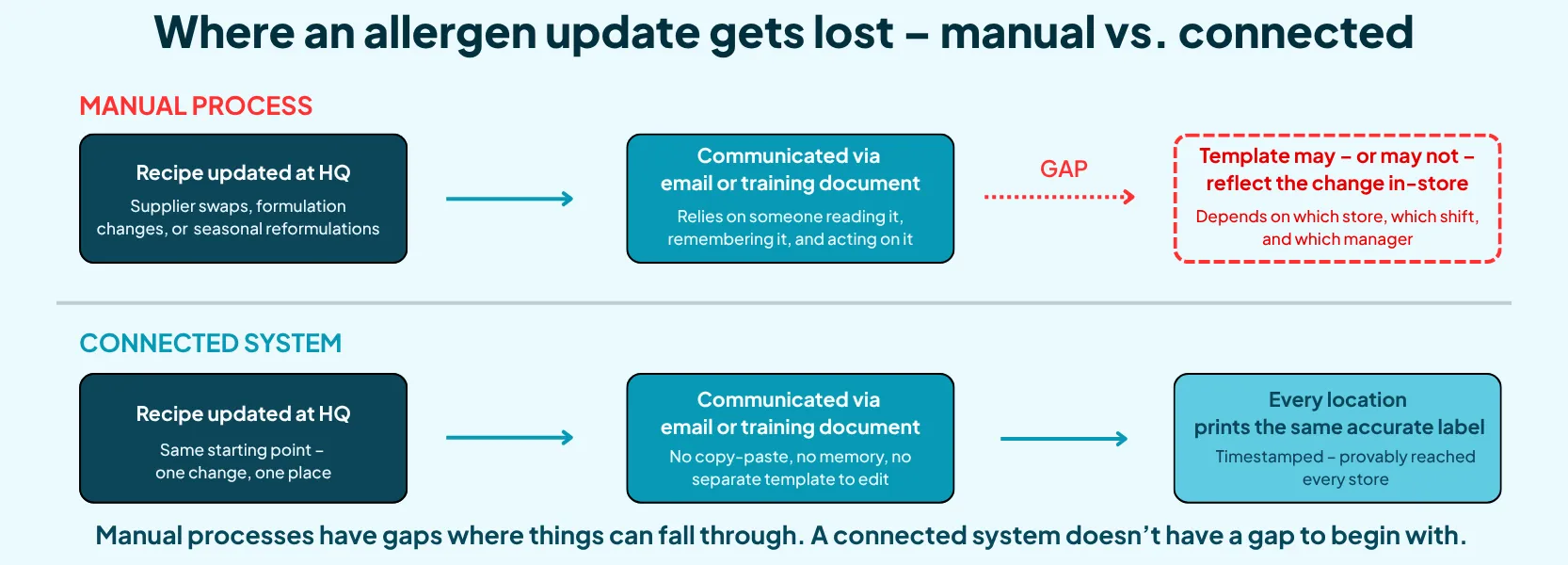
Templates go stale faster than anyone updates them. Recipe templates live on a device in the back of the kitchen. When headquarters changes something — a supplier swaps an ingredient, a formulation shifts, a seasonal item comes back slightly different than last year — that update has to travel through an email, a training note, and eventually somebody's memory before it reaches the actual label. In a single well-run kitchen, that chain mostly holds. Across two hundred locations and a few thousand employees, some link in it is going to snap. That's always cost operators money. Now it can also produce a label that's flatly against the law.
Allergen accuracy should come from the recipe, not from whoever's printing today. The most dangerous gap in a manual system isn't a typo — it's the space between what's actually in the food and what the label claims is in it. That information should trace straight back to the approved recipe: ingredients, formulation, supplier specs. When it doesn't, accuracy depends entirely on whether the person labeling happens to know exactly what changed and when, which is a lot to ask of anyone in the middle of a lunch rush.
And the more locations you run, the worse this gets — not better. A single-location operator can push a template fix in an afternoon. An enterprise operator rolling a change out to two hundred stores is basically running a small internal marketing campaign, and marketing campaigns have open rates. Some stores update immediately. Some ask questions. Some apply the new template to half the menu and miss the rest. Some keep running the old version until somebody physically walks in and checks. That's not a discipline problem. It's what happens to any manual process once you stretch it across enough locations.
What drift looks like the day an inspector walks in
Every enterprise operator already understands drift, even if nobody calls it that out loud. One store finds a shortcut. Another tweaks a template because it's "basically the same." A manager builds a slightly different process than the one three towns over. None of it looks like a decision at the time. It's just Tuesday.
Give that enough time and enough locations, and you end up with five versions of the same label floating around the system — which has quietly been true for years and mostly didn't matter, because the only person who ever noticed was a district manager on a routine visit.
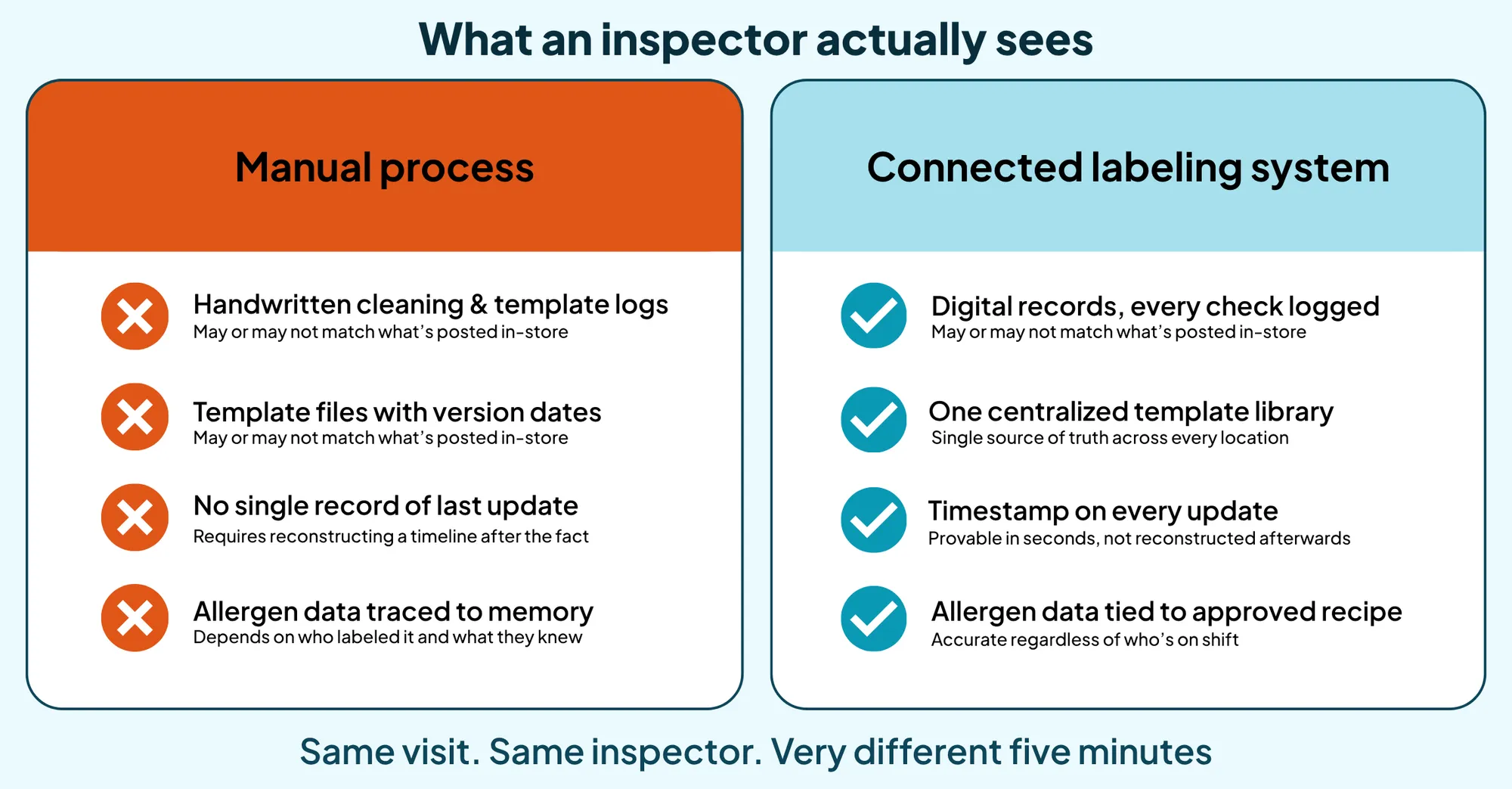
That's the part that's different now. When a district manager finds inconsistent labels, it's a coaching conversation. When a health inspector finds a prepackaged sandwich with no allergen declaration — or the wrong one — it's not a coaching conversation anymore. It's a finding. And a folder of handwritten logs next to a stack of template files with mismatched modification dates is not a great place to be standing when someone asks you to prove when that label was last checked.
There's also a wrinkle specific to running more than one location: a bad finding at Store 12 doesn't stay at Store 12. It travels under the same name that's on every other door in the portfolio. The exact consistency you've spent years building across the brand works against you here, because it means the story that follows one location follows all of them.
The audit most operators haven't run on themselves
Here's a five-minute exercise most compliance briefings skip right over: pull three prepackaged items from a grab-and-go case at three different stores. Check the allergen declaration on each label against the actual, current, approved recipe. Then check whether that recipe is this year's version or last year's.
In a connected labeling system, that's a five-minute exercise. In a manual one, it tends to turn into an afternoon — and it usually turns something up.
The gaps are rarely dramatic. Sesame gets listed inconsistently, because it's only been a required allergen since January 2023 and some templates never caught up. A supplier swaps a component, and the recipe gets updated in someone's head but not on the label. A seasonal item comes back this year with a slightly different formulation, running on a label printed for last year's version. A location quietly drifted onto its own regional template six months ago and nobody flagged it.
None of that started as an allergen failure. It started as ordinary operational drift, the kind every manual system accumulates whether anyone's watching or not. What §199-G does is take that familiar drift and reclassify part of it as noncompliance.
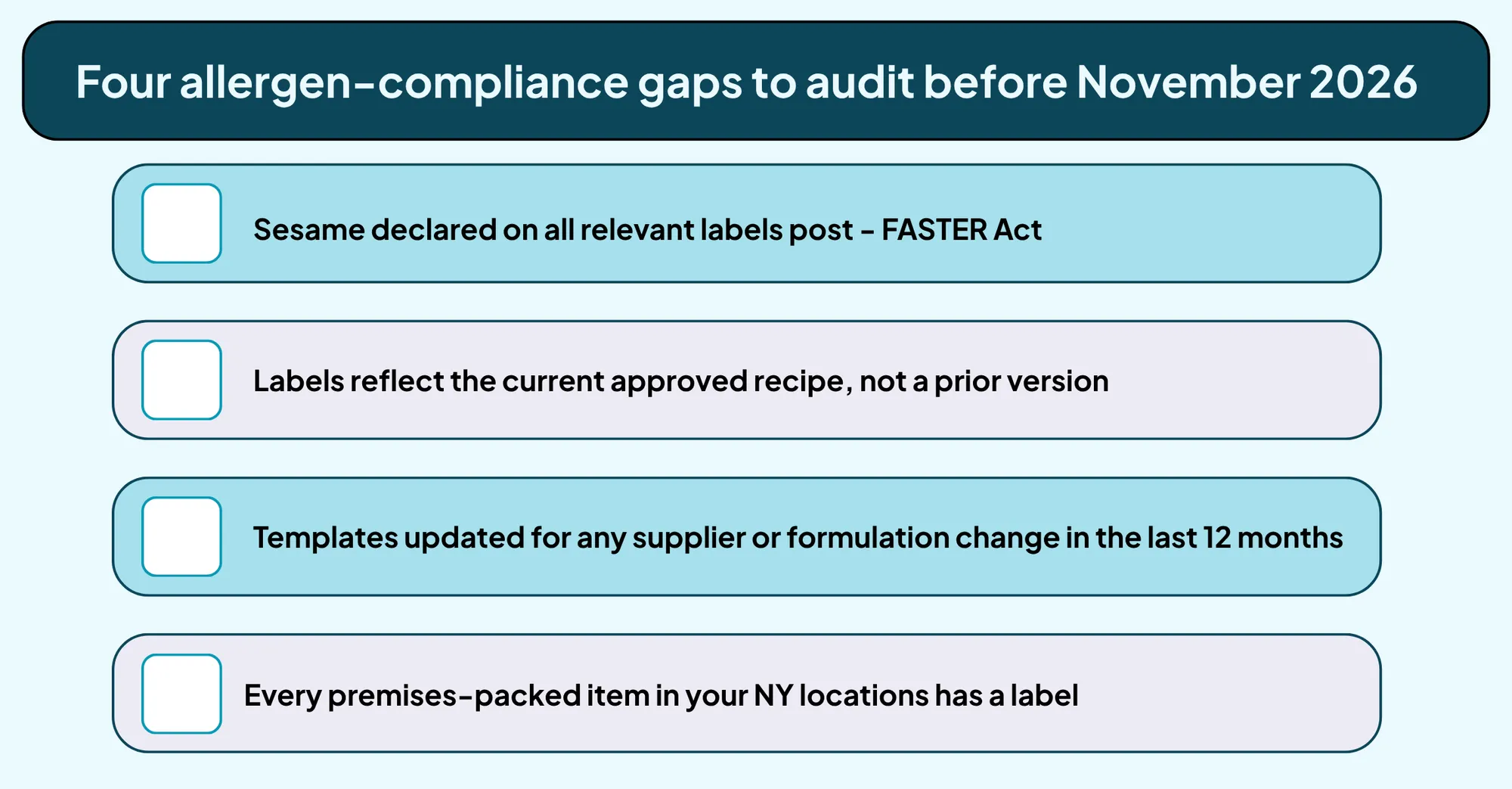
That's four of the gaps worth checking. Download the full Allergen Label Compliance Checklist to walk every prepackaged item through all three — whether it needs a label, what the label has to contain, and whether your process could hold up if an inspector asked you to prove it.
Building a process that doesn't rely on memory
The fix here isn't a faster printer or a stricter training binder. Those treat the symptom. The real issue is that manual labeling asks every single location to hold onto accuracy through human consistency alone — recipe knowledge, template discipline, catching every update — across an operation that might run thousands of employees and print millions of labels a year. That was always a lot to ask. It's more than a legal standard is willing to forgive.
Centralized food labeling software moves where that accuracy actually lives. Instead of every location keeping its own templates and hoping someone remembers to update them, the recipe data — ingredients, allergens, hold times, supplier specs — lives in exactly one place. Change a recipe at headquarters, and the label that prints from it changes too, automatically. There's no version of the template drifting out of sync with the recipe, because the recipe is the template.
That matters for §199-G specifically because an allergen declaration is only ever as good as the recipe data behind it. Connect the two directly, and you remove the exact steps where errors used to sneak in — the copy-paste, the "I think that update went out last week," the memory that's usually right but doesn't need to be tested against a statute.
BOHA! Food Prep lets approved recipe data populate labels directly instead of routing through someone's memory. Control Center gives headquarters one view of labeling activity across every location, so a corporate update is an update that provably reaches every store — with a timestamp to prove it.
That timestamp is the whole game. It's the difference between believing you were in compliance and being able to show it.
New York won't be the last state to ask this
New York didn't invent this idea in a vacuum. California's SB 68 took effect July 1, 2026, requiring large restaurant chains to disclose allergens on their menus. Maryland, Illinois, and Missouri have introduced their own versions, and legal trackers following the trend have already flagged a similar bill introduced in Michigan in December 2025.
So the real question for an enterprise operator was never whether allergen rules would keep expanding. They will. It's whether a process built for internal consistency can move as fast as a state legislature does.
If you're running manual labeling in New York right now, you're looking at a November deadline. If you're running it everywhere else, you're really just looking at a slower version of the same question: the next time a state passes a rule like this, how long does it take you to get every location caught up, and what does that scramble cost?
A system where a compliance update ships once and lands everywhere isn't just the easier way to run a kitchen. Increasingly, it's the only way to run one that can keep up.
Frequently asked questions
What does NY §199-G require foodservice operators to do?
Every food establishment must label all prepackaged food — food prepared, packed, and offered for sale on the same premises — with written notification identifying any major food allergen it contains. The law takes effect November 12, 2026. It does not require a full ingredient list, but every major allergen present must be declared on or attached to the package.
Does the NY allergen law apply to every size food establishment?
Yes. The law applies statewide regardless of size — delis, bakeries, sandwich shops, food trucks, and cafeterias are all covered. There is no location-count or revenue threshold that exempts a smaller operator.
How does manual labeling create allergen compliance risk?
Manual labeling depends on people keeping templates accurate and applying current recipe information consistently across shifts, staff, and locations. Every time a recipe changes — a new supplier, a reformulation, a seasonal swap — the label has to change with it. In a manual system, that chain of updates breaks more often than anyone would like to admit. In a connected system, the recipe drives the label, so one update reaches every location at once.
What is the difference between a labeling consistency problem and a compliance problem?
A consistency problem costs money through waste, rework, and friction. A compliance problem under §199-G adds the risk of a health department finding on top of that. The root cause is usually identical: templates that fell behind the approved recipe. The consequences are not, and the law does not treat good intentions as a mitigating factor.
How can a multi-location operator prepare for the November 2026 deadline?
Start by auditing the current process: which items count as prepackaged under the statute, whether existing labels declare all nine major allergens, and whether the templates in the field actually match the current approved recipes. Then ask whether your process can hold that accuracy as recipes keep changing, because this is not a fix you make once — it is a standard a manual system will keep asking you to re-earn by hand, indefinitely.