Stay in the loop!
Get the latest industry insights delivered straight to your inbox
The paper clipboard looks free. It just hides its cost in inspection risk, wasted labor, and blind spots that only show up when something goes wrong. Here's the actual business case for food safety software, beyond the sales pitch.
Dana Loof

Every multi-location operator has run the math on food safety software at some point, and a lot of them have talked themselves out of it with a familiar piece of logic: the clipboard already works, the binder is already full of signed logs, and a new system is one more thing to roll out, train on, and pay for.
That logic isn't wrong about the visible costs. A clipboard has no license fee. What it misses is that paper-based compliance doesn't eliminate cost, it just moves it somewhere less visible: into the labor hours spent filing and hunting for records, into the audit findings triggered by inconsistent documentation, and into the exposure that shows up only when a health inspector, a franchise auditor, or a plaintiff's attorney asks a question the paper system can't answer quickly.
The real comparison isn't "software costs money and paper doesn't." It's "which system's costs are you willing to see, and which ones are you willing to keep absorbing without ever putting a number on them."
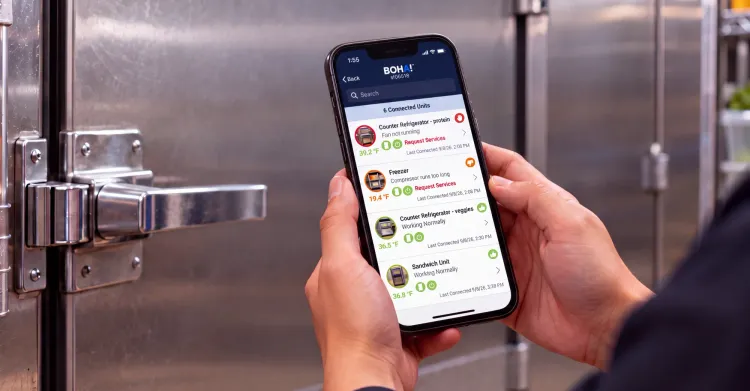
The category gets used loosely enough that it's worth being precise. Food safety software, in the context most multi-location operators actually need, means a connected system rather than a single tool: some combination of digital HACCP logging, temperature monitoring, task and checklist management, and corrective-action documentation, tied together so a compliance record from one workflow can be cross-referenced against another. In practice, that can mean equipment monitoring from BOHA! Sense feeding the same HACCP report as manual checks from BOHA! Temp and completed tasks from BOHA! Checklist, so a health department review pulls from one place instead of three separate logs. Digital HACCP Records That Prove Compliance walks through what that actually looks like day to day, at the workflow level rather than the category level.
That distinction matters because a lot of operators have already digitized one piece of this, a temperature app here, a checklist app there, without connecting them. That's a meaningful improvement over pure paper, but it's not the same as an audit-ready system. An auditor doesn't ask "was the temperature logged." They ask "was the temperature logged, was it out of range, and if so, what corrective action was taken, by whom, and was it verified." Answering that chain of questions requires the pieces to be connected, not just digitized independently.
It's worth separating this from a related but different question a lot of multi-location operators are also working through, whether to consolidate an already-digital tech stack that's grown into a pile of disconnected point solutions. That's a real conversation, and we've covered the framework for it separately. This piece is narrower, about what happens when the record in question is still a binder rather than a disconnected app, and what "connected" needs to mean before that binder can be retired.
Framing this as a paper-versus-digital debate undersells what's actually at stake. The deeper issue is visibility, whether headquarters knows, in something close to real time, what's actually happening at every location, or only finds out when something has already gone wrong.
A paper-based system is, by design, local and retrospective. Records live at the location until someone requests them, which means a systemic problem, a specific item consistently out of temperature range, a checklist step consistently skipped at the same time every week, a pattern across several locations in one region, is essentially invisible from headquarters until an inspection or incident forces a manual review.
A connected digital system flips that. Instead of compliance data sitting dormant in a binder until it's requested, it's aggregated continuously, which means a food safety or operations team can see patterns forming across the portfolio and intervene before they turn into a failed inspection or a foodborne illness incident. That shift, from reactive to proactive, is the actual argument for food safety software. The audit-readiness benefit is real, but it's a downstream effect of the visibility, not the whole point.

A few specific failure points show up consistently once an operation grows past a handful of locations:
Inconsistent documentation quality across sites. One location's log book might be meticulous. Another's might be, functionally, a formality filled in at the end of a shift. Paper gives headquarters no reliable way to know which is which without visiting or requesting records from every site.
No portfolio-level early warning. A pattern that would stand out immediately in connected data, corrective actions repeatedly going unresolved in one district, the same checklist step consistently skipped across several stores, or compliance exceptions concentrated around the same shift, is nearly impossible to spot manually across dozens or hundreds of separate local records.
Slow, manual audit prep. When a franchise review, internal audit, or health inspection is scheduled, someone has to physically gather, review, and often re-organize weeks or months of paper records, a task that pulls a manager off the floor and rarely happens with much lead time. Multiply that across every location involved in a portfolio-wide review, and it stops being one manager's bad week and becomes a real, recurring operational cost.
Records that are hard to defend. As covered in Temperature Logs That Survive an Audit: Paper vs. Digital, inconsistent handwriting, suspiciously uniform entries, and missing corrective-action documentation are exactly what trained inspectors and auditors are looking for, and paper makes all three easier to produce by accident.
No connection between systems. A temperature reading, a checklist completion, and a corrective action might all be recorded, but if they're recorded in three different places by three different people, reconstructing the full story of what happened requires manual detective work every single time.
Individually, each of these looks like a local, fixable problem. Aggregated across a portfolio, they're the reason headquarters usually finds out about a systemic issue after an inspection or incident forces the question, not before.

An audit-ready compliance record should be able to answer five questions on demand, for any location, without anyone reconstructing the story by hand:
1. What happened? The reading, the completed task, or the deviation itself, timestamped as it occurred, not backfilled later.
2. Where? Tied to a specific location and unit, not a generic entry that could belong to any site.
3. What action followed? The corrective step taken, and by whom, linked to the same event rather than filed separately.
4. Was it verified? A follow-up confirmation that the fix actually worked, not just a note that a problem existed.
5. Is it happening anywhere else? The question physically separate records can't answer on demand, whether the same failure is repeating across other locations right now.
Paper can sometimes answer the first four with enough discipline at a single, well-run location. Answering the fifth requires someone to manually gather and compare records across sites. A connected system like BOHA! Control Center removes that retrieval and reconciliation step entirely, making portfolio-level patterns visible as they form rather than after someone goes looking for them.
The financial case for food safety software is rarely about a single dramatic event, and framing it that way tends to undersell the argument. The USDA Economic Research Service estimates the annual cost of foodborne illness in the U.S. at $74.7 billion, a figure that captures just how much is at stake industry-wide even before accounting for the brand damage, litigation exposure, and lost customer trust a single operator faces after an incident traced back to their business.
For most operators, the more immediate and measurable return comes from three places: labor hours reclaimed from manual audit prep and record reconciliation, faster detection of small problems before they become inspection failures or incidents, and reduced exposure during litigation or regulatory review, where a clean, connected, defensible record is worth far more than a stack of paper with gaps in it. None of those show up as a single dramatic line item. All three compound, quietly, the same way paper's hidden costs do, just in the opposite direction. Operators sizing up that return for their own portfolio can start with TransAct's ROI calculator rather than a rough estimate.
The clearest starting point is the operation's own audit and inspection history, not a cost estimate or a vendor comparison. A location, or a region, that's already had a documentation finding, a franchise audit that flagged inconsistent logs, or a corporate team that's had to manually reconstruct a timeline after an incident, has already shown you where the paper system is weakest. That's the gap worth closing first, not because it's the cheapest or fastest to roll out, but because it's the one most likely to cost real money or real risk again before a broader rollout ever finishes.
For many operators, that starting point often turns out to be corrective-action documentation or temperature logging, since those are the records inspectors ask about first, and temperature logs in particular are prone to the pencil-whipping problem covered in Temperature Logs That Survive an Audit: Paper vs. Digital. Corrective-action documentation in particular ties back to the critical control points already defined in most operators' HACCP plans, which is exactly why disconnected logging makes that chain so hard to reconstruct after the fact. A connected platform approach, built to layer temperature monitoring, digital checklists, and HACCP logging on the same foundation rather than as separate standalone tools, closes that highest-risk paper gap first, without asking a kitchen team to change everything about how they work in one week.
The goal isn't to declare paper the enemy on principle. Paper's costs, in labor, in audit risk, in blind spots headquarters can't see until it's too late, are real even when they're invisible on a P&L. Closing them doesn't require reinventing how a kitchen works. It requires connecting the pieces already tracking the right information, so the answer to "what happened, and what did we do about it" is always one query away instead of one manual search away. Whichever paper process turns out to be the highest-risk gap, that's the Food Safety & Compliance question worth answering first.
Food safety software, sometimes called food safety compliance software, refers to connected digital tools that manage food safety compliance activities such as temperature monitoring, HACCP logging, digital checklists, and corrective-action tracking, typically integrated so records from different workflows can be cross-referenced during an audit or inspection.
The visibility and audit-readiness benefits scale with the number of locations, since paper-based systems become harder to manage consistently as an operation grows. Single-location operators can run compliant paper programs with strong discipline, but most see diminishing returns from that approach once they expand beyond a handful of sites.
A standalone temperature app digitizes one piece of compliance but doesn't necessarily connect to checklist completion, corrective-action records, or other workflows. True food safety software ties these pieces together so an auditor's full chain of questions, what happened, what was done about it, and was it verified, can be answered from one connected record.
Start with whatever your last audit, inspection, or internal review already flagged. A documented gap, an inconsistent log, or a record request that took longer than it should have is a reliable signal of where paper is failing before it becomes a companywide failure point. That's often corrective-action documentation or temperature logging, since those are the records inspectors ask about first.
The costs are mostly indirect: labor hours spent on manual audit prep, slower detection of systemic problems across locations, and higher exposure during litigation or regulatory review when records are inconsistent or incomplete. These rarely appear as a single line item, which is exactly why they're often underestimated.
Get the latest industry insights delivered straight to your inbox
Browse