Stay in the loop!
Get the latest industry insights delivered straight to your inbox
Pencil-whipped temperature logs pass a glance and fail an audit. See what inspectors actually check, where paper temperature log sheets break down, and how digital logging closes the gap before your next visit.
Dana Loof
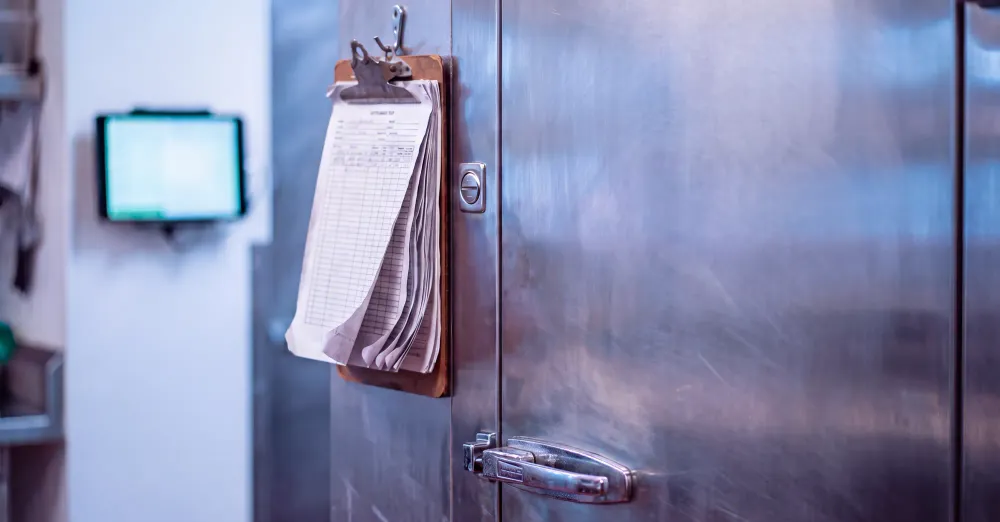
Before a health inspector walks the line, checks a walk-in, or asks a single question, they ask for the log book. It's the fastest way to learn how an operation actually runs, not how it says it runs. A temperature log sheet is a paper trail of intent: did someone check the walk-in at 6 a.m. like the schedule says, and did they do something when the reading was wrong?
That's also exactly why temperature logs are the first thing that falls apart under scrutiny. Multi-location foodservice operators know the pattern well. A shift lead is slammed during the lunch rush, the 11 a.m. check gets missed, and at 2 p.m. they fill in a plausible number for every box on the sheet, all at once, in the same pen, with suspiciously consistent handwriting. In the industry, this has a name: pencil whipping.
It's not usually malicious. It's a symptom of a system that asks a busy person to do a manual, repetitive task with no real-time accountability and only a distant, occasional consequence for skipping it. But the consequence isn't distant when an inspector or an internal auditor is standing in front of that log, and it isn't small.
Falsified or backfilled temperature logs create three compounding problems for an operator running more than a handful of locations.
The first is the food safety risk itself. A temperature log is only useful if it functions as an early warning system. If entries are being filled in from memory or invented outright, the operation loses its actual signal that a cooler is failing or a hot-holding unit has drifted out of range. CDC's most recent national outbreak analysis consistently shows that inadequate cold holding and improper cooling remain leading contributing factors in restaurant-associated foodborne illness outbreaks, and both are exactly the failures a real-time temperature log is designed to catch before anyone gets sick.
The second is the audit and inspection risk. A trained inspector, franchise auditor, or third-party compliance reviewer can usually spot a pencil-whipped log within seconds: identical time intervals, suspiciously round numbers, or an unbroken run of entries in one sitting after the shift change. Once one log is flagged as unreliable, an auditor's confidence in every other record in the building drops with it, which tends to extend the visit, widen its scope, and raise the odds of a documented violation.
The third is the liability exposure that shows up much later. If a foodborne illness incident is ever traced back to a location, temperature records become evidence. A log that shows a corrective action taken within minutes of an out-of-range reading tells a very different story in a legal or regulatory review than a log that shows nothing was ever out of range, ever, across every shift, at every location, for months at a time. Inspectors and attorneys both know that's not what real operations look like.
Most operators assume an inspector is scanning for numbers that fall outside a safe range. That's part of it, but it's not the main thing being evaluated. Inspectors are trained to read a temperature log the way an auditor reads a financial statement: for the pattern behind the numbers, not just the numbers themselves.
Specifically, they're looking for:
Chronological plausibility. Do the recorded times match the actual operating hours and shift patterns of the location? A refrigerator temperature log with entries logged every hour, 24 hours a day, at a restaurant that closes overnight, is an immediate red flag.
Natural variation. Real temperature readings fluctuate by a degree or two between checks, even in a well-maintained unit. A log where every single reading lands on the exact same number reads as fabricated, not as evidence of excellent equipment.
Documented corrective action. This is the one operators most often miss. The FDA Food Code doesn't just require that food be held at a safe temperature — it requires that when it isn't, someone documents what they did about it. A blank log with no out-of-range readings at all, ever, is frequently viewed more skeptically than a log with a handful of documented catches and fixes, because the second one looks like a system that's actually being used.
Handwriting and ink consistency. For paper logs specifically, an inspector who suspects batch-filling will often flip back several pages and compare pen color, pressure, and handwriting style across entries that are supposed to be hours apart.
Frequency compliance. Most jurisdictions require temperature checks at specific intervals for Time/Temperature Control for Safety (TCS) foods — often every four hours for items held hot or cold — and an inspector will check the log against that requirement directly.
Paper isn't inherently the problem. A single-location, tightly managed kitchen with a strong culture of accountability can run a compliant paper temperature log program for years. The breakdown almost always shows up at scale, and it shows up in predictable places.
Paper logs have no built-in enforcement. There's no mechanism that stops a busy shift lead from filling in four hours of entries at once, and no automatic flag when a check is simply skipped. The system relies entirely on individual diligence, shift after shift, location after location, with no visibility into which locations are actually doing it right until an inspector or auditor happens to look.
They're also difficult to aggregate. A single binder in a single kitchen is manageable. Two hundred binders across two hundred locations, each with its own filing habits, is not something a headquarters food safety team can meaningfully audit on a rolling basis. Corporate visibility into compliance becomes reactive: problems surface after an incident or a failed inspection, not before one.
And paper logs are trivially easy to lose, damage, or misplace exactly when they're needed most, whether that's during a spilled-drink accident in the back office or when a specific record is requested during litigation two years after the fact.
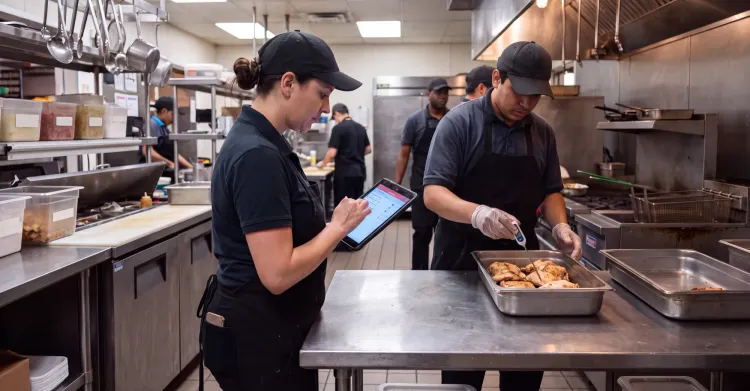
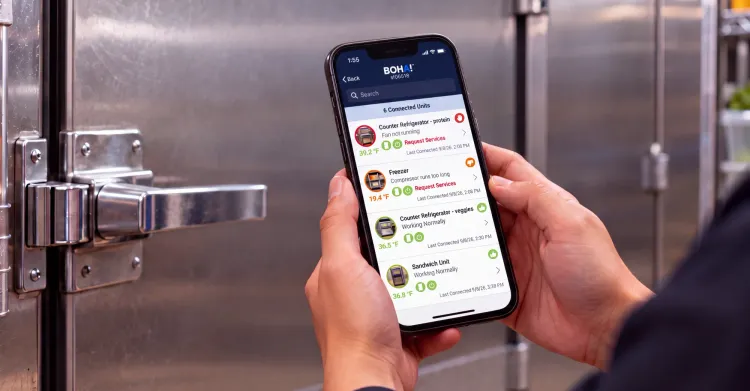
A digital temperature monitoring system, like BOHA! Temp, changes the mechanics of the record itself: entries are timestamped the moment they're taken, an out-of-range reading can prompt a corrective action on the spot, and a compliance team gets a live, aggregated view across every location instead of requesting binders before a franchise review. We've covered that mechanical shift in full in Digital HACCP Records That Prove Compliance — the short version here is that it turns temperature logging from a defensive paperwork exercise into the early-warning system it was always supposed to be.
It's worth separating two things that often get treated as the same problem. A refrigerator temperature log is a single, narrow record: is this one unit holding a safe temperature at the times it's checked? A temperature compliance program is the full system around it, covering hot-holding, cold-holding, cooling logs, receiving checks, and the corrective-action workflow that ties all of it together. For most operators, that full system is also the recordkeeping backbone of a documented HACCP plan — temperature checks are typically the critical control points a HACCP plan requires you to monitor and record.
Operators running a handful of locations can often manage the narrow version with discipline and a good paper system. Operators running fifty, a hundred, or several hundred locations need the broader program, because the question stops being "is this fridge okay" and becomes "how do I know, across every location, on any given day, whether the whole system is working." That's a different problem, and it's the one digital temperature monitoring is actually built to solve.
Whether a location is on paper, digital, or transitioning between the two, an audit-ready program tends to share the same core elements:
1. Fixed check intervals that match local requirements. Know the actual frequency your jurisdiction requires for hot- and cold-holding checks, and build the schedule around it rather than a rough estimate.
2. A documented corrective-action step for every out-of-range reading. What was the reading, what did the team do about it, and what was the follow-up reading that confirmed it was resolved.
3. A review cadence, not just a filing cabinet. Someone above the shift level should actually be looking at logs on a regular schedule, not only when an inspection is scheduled.
4. Consistency across locations. A regional manager should be able to pull the same type of record, formatted the same way, from any location in the portfolio.
5. A clear escalation path. Frontline staff need to know exactly what to do, and who to call, when a unit is out of range and can't be corrected on the spot.
Getting these five elements right matters more than which format the log itself takes. But at scale, digital systems make all five dramatically easier to actually sustain, week after week, across every location, without relying on individual willpower.
Fixing the temperature log itself is the tactical starting point. The broader argument for making that fix at a platform level, not just a tool level, is the same one behind TransAct's Food Safety & Compliance approach: one connected system for temperature checks, corrective actions, and audit records, instead of a separate fix for each gap as it turns up.
Requirements vary by jurisdiction, but the FDA Food Code generally calls for monitoring at intervals frequent enough to catch a problem before food spends more than four hours in the temperature danger zone. Many operators check hot- and cold-holding units at least every four hours as a result. Always confirm the exact interval with your local health department, since adopted versions of the Food Code differ by state and county.
Often, yes. Inspectors are trained to look for identical time gaps between entries, uniform handwriting or ink, and a lack of natural variation in the readings, all of which suggest a log was completed in a single sitting rather than throughout a shift.
No. Digital systems make it easier to prompt for and capture a corrective action at the moment a reading is out of range, but the documentation requirement itself doesn't go away. The advantage is that the system can require the entry before letting staff move on, rather than relying on memory.
Yes, in virtually all jurisdictions digital records are accepted as valid documentation, provided they're accessible for the inspector to review on-site. Most operators keep records available on a tablet, terminal, or connected dashboard for exactly this reason.
Get the latest industry insights delivered straight to your inbox
Browse