Stay in the loop!
Get the latest industry insights delivered straight to your inbox
Health inspections are won or lost on documentation. See how BOHA! Temp and BOHA! Sense help reduce pencil whipping by streamlining everyday food safety and temperature checks, automating continuous monitoring, and documenting corrective actions in audit-ready digital HACCP records—so compliance is…
Stephen Crump
A health inspector rarely doubts that a kitchen wants to serve safe food. What they need to see is evidence: that the checks were done on schedule, by someone accountable, with a documented response every time a reading came back out of range. A confident answer and a clean-looking kitchen are a great sign but count for very little if the records behind them are thin.
For most operators, those records still live on a clipboard or in a binder somewhere near the walk-in. Handwriting is rushed or paper wanders off, gets rained on by a leaky reach-in, and turns illegible by the third shift. Even at its best, a stack of handwritten logs is a weak way to prove a kitchen has been running safely for weeks on end.
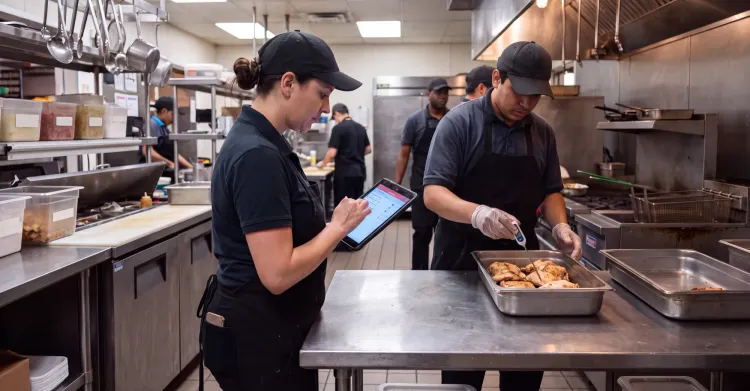
BOHA! Temp replaces that stack with a guided digital workflow. Staff are directed through each food safety check in turn, the right corrective action appears on screen the moment a finding lands out of range, and every one of those actions rolls up into a digital HACCP record that is ready long before anyone from the health department shows up.
After years of building back-of-house tools, the pattern keeps coming back to is this: temperature is never the hard part of food safety. Anyone can read a probe. What breaks down, shift after shift, is the trail of evidence around the step taken, who took it, when, and what actions were taken when things went wrong. In short, proof that not only was the job done, but done right. Kitchens do not fail inspections because their staff do not care. They fail because detailed notes are not the main priority of a busy kitchen; delivering the highest quality food and service to patrons is the goal. The truth is it’s difficult to deliver at the highest level while also keeping track of every little nuanced, repetitive step taken to prove the highest level was products correctly. When relying on manual process, the honest work from that kitchen has a hard time making it onto paper in a credible form for posterity. By addressing this difficulty, compliance stops being a scramble and starts being a byproduct of doing the job well, giving time back to staff to focus on delivering at the highest level.
BOHA! Temp is a digital food safety and compliance tool that guides foodservice teams through the checks that keep a kitchen safe and legal, prompts time-bound corrective actions when a finding is out of range, and records the result as a digital HACCP report. It runs on handheld, mobile devices (iOS and Android) or on BOHA! hardware already on-site.
In short: BOHA! Temp is a digital food safety workflow tool that guides teams through required food safety checks, prompts corrective actions when readings or findings fall out of range, and compiles the results into audit-ready digital HACCP records.
If you have seen BOHA! Checklist in action, Temp will feel familiar since it runs on the same guided workflow engine. Checklist covers operational tasks. Temp covers food safety and health-code compliance, applying that same step-by-step discipline to the side of the operation an inspector cares about most.
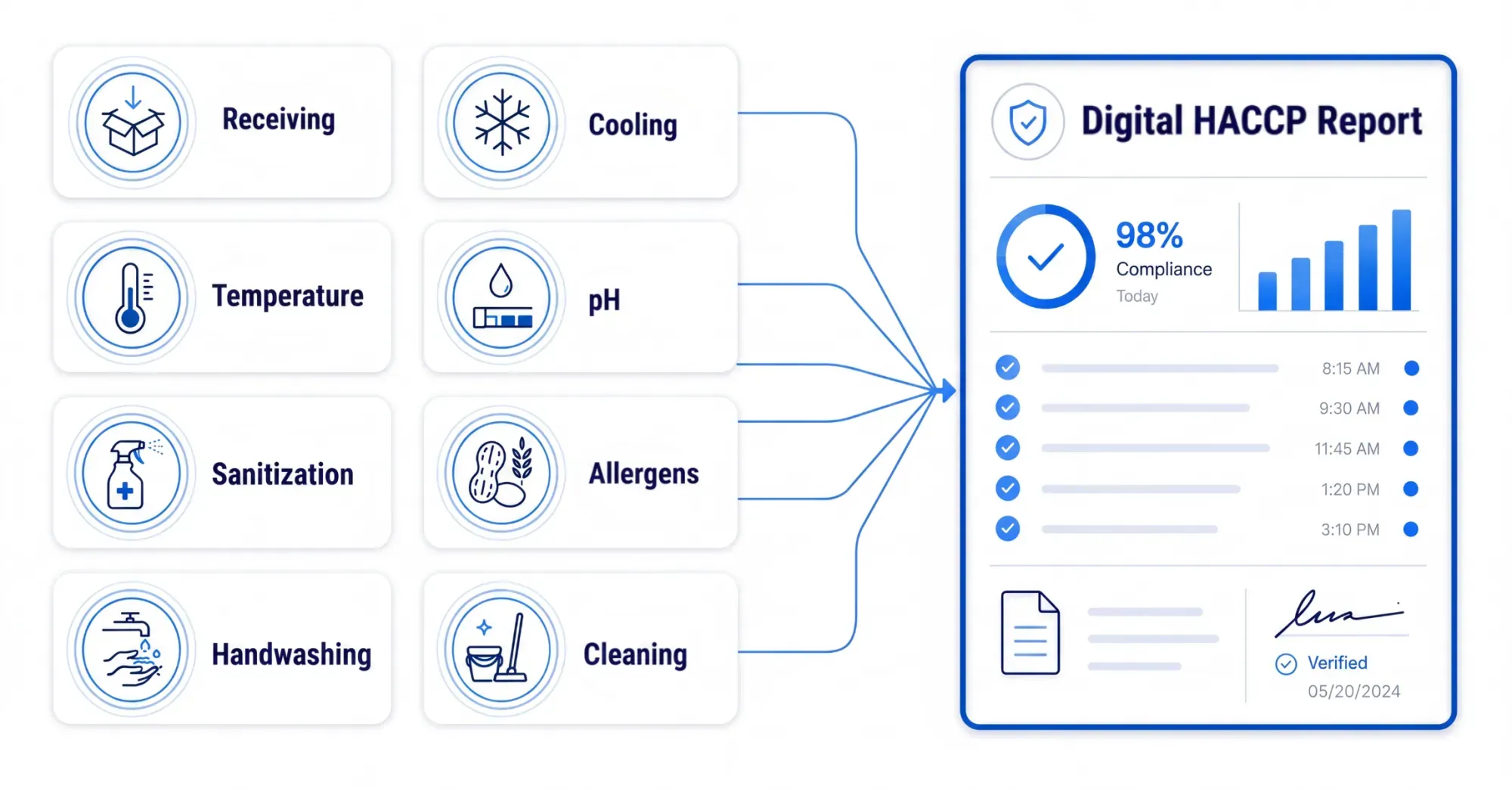
A temperature reading is one data point. A HACCP report is the whole picture: every critical control point a kitchen monitors, every reading taken, every corrective action logged, and proof that each one was handled by an accountable person at the right time. Temperature is part of that picture. So is receiving, cooling, sanitizing, allergen handling, and cleaning, and together they demonstrate compliance with the health codes a restaurant operates under.
Temp is flexible by design, and lets any jurisdiction’s requirements be built in as a step in the workflow, including:
Every one of those steps flows into the same place. The finished records appear as digital HACCP reports in the BOHA! Ops app, and a manager can pull the day’s food safety standards at any time, from any location.
It helps to be precise about where food safety requirements actually come from, since the terms get used loosely. The FDA publishes the Food Code as a science-based model, but it is not federal law. It is guidance offered for states and localities to adopt. FDA’s own adoption tracking confirms that restaurant and retail food oversight is handled at the state and local level, not the federal level, which is why the specific code edition in force, and the exact rules an inspector checks against, vary by jurisdiction.
State and local health departments are the ones who adopt a version of the code, issue permits, run inspections, and hold the legal authority to cite a restaurant for a violation. A formal, written HACCP plan is not a universal requirement for every restaurant. Most quick-serve and full-service kitchens operate under active managerial control instead. A written HACCP plan is typically required when a kitchen runs a specialized, higher-risk process, and the list is more specific than most operators expect.
| Specialized process | Example |
|---|---|
| Reduced oxygen packaging | Sous vide, cook-chill, vacuum packaging |
| Curing or smoking as preservation | Cured or smoked meats |
| Live product display | Molluscan shellfish tanks |
| Additive-based acidification | Sushi rice prepared with vinegar to hold outside temperature control |
That last row is why BOHA! Temp’s pH capture is built specifically for sushi rice: acidifying rice to render it safe to hold outside refrigeration is exactly the kind of process that triggers a variance and a written HACCP plan in most jurisdictions, and the readings need to be documented as precisely as any temperature check.
This is also why Temp does not tell you what your jurisdiction requires. No software can, since the requirement depends on city, county or state laws, your process, and what the local enforcement agency, whether it be the health department or in some cases the agriculture department, has adopted. What it does is give you the flexibility to build any of it into the workflow, so whatever your local code demands becomes a step your team runs consistently rather than a rule buried in a binder.
Most food safety failures trace back to a gap in accountability rather than a gap in knowledge. A check gets skipped, a reading goes unrecorded, or a corrective action happens, but no one can say who did it or when. Paper cannot close that gap, because it captures a result without capturing responsibility. The fix is to make accountability a property of the workflow itself, so the record of who did what is created automatically as the work happens, rather than reconstructed afterwards.
In practice, that means the system has to serve two very different people at once. A manager needs to design the program and then verify it is running. Kitchen staff need to be told, in the moment, exactly what to do next. BOHA! Temp is built around that split.
Managers set up the workflow, the steps staff need to run consistently to keep food safe, and the corrective-action guidance that kicks in when a finding lands outside acceptable parameters. Then they review the output. Digital HACCP records are there on demand, so a manager can confirm the program is actually running, across a shift or across a region, without standing on the line to watch it happen.
For the person in the back-of-house, Temp is a step-by-step guide through everything that has to be done to keep the back-of-house safe. It tracks time-dependent items and holds each action to a window, so an SOP or a corrective action gets done when it needs to be done.
There is nothing sinister about a clipboard, a binder, or a paper log. These formats simply cannot meet the regulatory expectations in place today. The same failure patterns show up in kitchen after kitchen:
Pencil whipping is the industry term for what happens when staff skip the actual check and fill in a log with fabricated readings and approvals, to save time or hide noncompliance. It is usually less a character issue than a tool, workflow, or process one: the check is inconvenient, the shift is short-handed, the log is due, and nobody looks at that page until an inspector does.
This is worth grounding in real numbers rather than intuition. CDC tracks and reports on the causes of foodborne illness outbreaks nationally, and in its review of outbreak data reported from 2014 to 2022, the CDC found that inadequate food temperatures remain a common cause of bacterial outbreaks, with inadequate hot and cold holding appearing again and again among contributing factors. Separately, CDC survey data on why staff skip steps points to time pressure and short staffing as leading reasons. None of that data sets policy on its own, but it explains why the gap between what a log says and what actually happened is not a hypothetical risk.
A paper log cannot tell you whether a number came from a probe or from a pen. A digital check, timestamped and tied to the person who ran it, can.
A log that only notes an out-of-range reading has documented a problem without solving it. The operational goal is to close the loop while the food is still recoverable, which means the response cannot depend on whichever staff member happens to be nearby or how well they remember the standard. When the corrective action is prompted automatically, timed, and tied to the reading that triggered it, the outcome stops varying by shift. This is where BOHA! Temp does its most concrete work, and the exact flow depends on what triggered the alert.
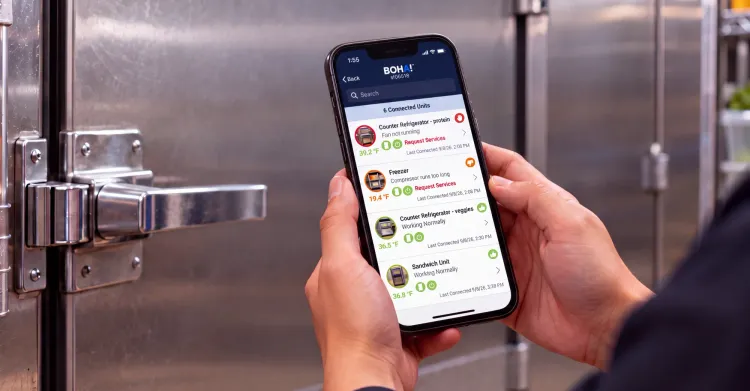
Staff open the flagged unit and select Requires Action. Temp walks through Check Settings, then a wait period to let the temperature recover, then a re-check. If the reading is still out of range after that, the final step is Contact Manager or Call Service. Every step in that sequence requires a PIN sign-in, so the record shows exactly who checked the settings, who waited it out, and who made the call. Equipment monitored by BOHA! Sense feeds into this same workflow, so a fridge’s temperature drift can be caught overnight before the food spoils, becoming a Temp corrective action the moment readings fall outside of the safe range. Not fun to get this call at 1am, but much better than losing your entire inventory of ingredients.
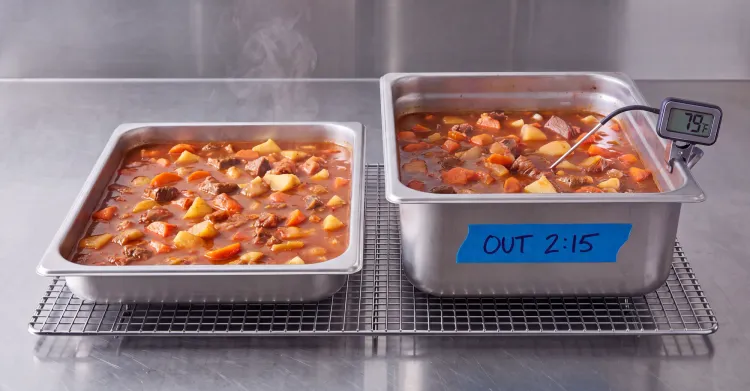
Staff log the final cook temperature, and a cooling timer starts, synced with the BOHA Timer App, matching the two-stage window the Food Code lays out for cooked TCS food: down to 70°F within the first window, then down to 41°F within the second. At each gate, the system requires a fresh reading before it will let the process continue. Hit both windows and the record closes out as in range. Miss one, and the corrective action path opens instead.
| Situation found | Typical response |
|---|---|
| Hot TCS food below 135°F, within the time window | Reheat rapidly to 165°F for 15 seconds, then return to hot holding |
| Hot TCS food below 135°F, beyond the time window | Discard and document the disposal |
| Cold TCS food above 41°F, within the time window | Rapidly chill, or move the product to a working unit, then recheck |
| Cold TCS food above 41°F, beyond the time window | Discard and document the disposal |
| Cooling stalls above 70°F at the first gate | Reheat and restart cooling, or discard, per your plan |
| Equipment still out of range after the wait period | Contact manager or call service, and log the outcome |
Every action in either flow, and every reading that triggered it, lands on the same daily HACCP log, with the employee, the timestamp, and a check or an “X” next to each step so a manager or an inspector can see exactly what happened and who was responsible.
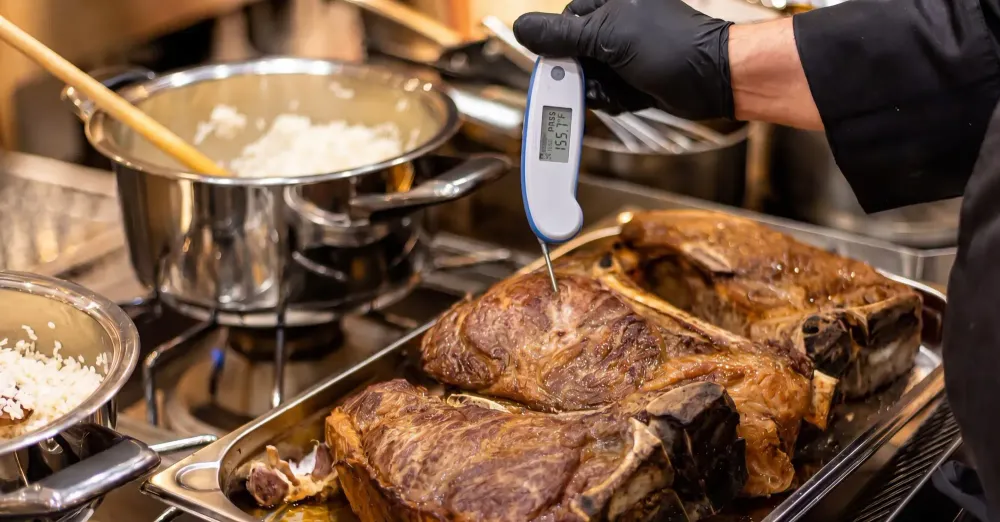
Most operators already have probe preferences, approved hardware, and calibration procedures, and Temp is built to work with them. It captures readings from a set of approved Bluetooth temperature and pH probes, so the measuring tool stays yours while BOHA! adds the workflow, the corrective actions, and the record on top.
Standardizing new hardware across locations? Consult an expert about the current approved-device list before you buy, and see USDA FSIS guidance on food thermometers for a primer on types, placement, and calibration.
BOHA! Temp documents the checks your team performs on the food. BOHA! Sense watches the equipment those foods sit in, and the two are more tightly connected than they might look at first. Install the gateway and sensors in the walk-in, the refrigeration units, or dry storage, and Sense monitors conditions around the clock. When a unit drifts out of range, that event shows up directly inside Temp’s corrective action workflow, and staff resolve it, sign it off, and log it the same way they would any other equipment finding. We covered the equipment-monitoring side in the previous BOHA! Built post on remote temperature monitoring for foodservice. This is how the two connect.
| Operational need | BOHA! tool |
|---|---|
| Guided food safety checks and health-code compliance workflows | BOHA! Temp |
| Prompted corrective actions when a finding is out of range | BOHA! Temp |
| Cloud-stored digital HACCP records on demand | BOHA! Temp |
| Always-on temperature and humidity monitoring of equipment | BOHA! Sense |
| Overnight drift alerts that route into a Temp corrective action | BOHA! Sense + BOHA! Temp |
| Operational tasks, maintenance, and SOP verification | BOHA! Checklist |
| Prep, date-code, and grab-and-go labeling | BOHA! T2 or WorkStation |
| Receipts and tickets at the counter or back-of-house station | Ithaca 9000 |
That native connection is the point, and it holds across the whole platform. BOHA! Temp, Sense, and Checklist are not separate tools stitched together, but are just some of the applications of the same interconnected BOHA! Platform, built from the ground up to work as one. Temp governs food safety, Sense watches the equipment, and Checklist runs the operational work around them, opening and closing routines, maintenance, and SOP verification, all on the same engine inside the same app. Because they share that foundation, an operator gets one connected view of the back of house rather than three systems to reconcile: the food, the equipment it depends on, and the daily work that keeps both on standard.
At a single store, a digital HACCP record is a better binder. Across fifty stores, it becomes something else entirely.
There is a second payoff that shows up before the audit does. A real-time alert on an out-of-range cooler is not only a food safety signal, but it’s also an inventory signal. Catching a failing unit at the moment it drifts, rather than at the next manual check, is often the difference between moving product and discarding it. Prevention of loss and proof of compliance turn out to be the same discipline viewed from two angles.
Once food safety is digital, completion becomes a metric, and out-of-range findings become a trend line a brand can actually see: which locations are running their checks, which ones are logging corrective actions, and where a piece of equipment or a process is quietly failing across a region. That is visibility food safety and operations leaders can act on, without waiting for a store visit or a bad inspection score to find out something was wrong.
It is also how brand standards stop being a binder and start being something you can measure, so staff get to focus on service instead of a pre-inspection scramble, because the record is already built.
BOHA! Temp can be a strong fit for teams that need:
This piece closes out the first installment of the BOHA! Built series. Here is what we have covered so far:
| Hardware | What it does |
|---|---|
| BOHA! Terminal 2 | Fixed, high-volume labeling and workflow access at the prep station |
| BOHA! WorkStation | Mobile workflow access wherever the work is happening |
| Ithaca 9000 | Compact thermal receipt and label printing |
| BOHA! Sense | Around-the-clock equipment temperature and humidity monitoring |
| BOHA! Temp | Guided food safety checks, corrective actions, and digital HACCP records |
BOHA! Temp
Guided food safety checks, corrective actions, and digital HACCP records
Across BOHA! Terminal 2, WorkStation, the Ithaca 9000, Sense, and Temp, the integrated hardware for the BOHA! software brings operational automation into the physical places where back-of-house work happens: the label station, the display case, the delivery counter, the walk-in, the prep table, and the audit record. Together, these tools help operators connect daily execution to the standards, visibility, and consistency their food programs depend on.
If you want to see what that looks like in your kitchens, consult an expert.
BOHA! Temp is a digital food safety and compliance tool that guides foodservice teams through required food safety checks, prompts corrective actions when a finding is out of range, and compiles the results into digital HACCP records. It captures temperature and pH readings through Bluetooth probes, and structures every other food safety step, from receiving to cleaning verification, into the same guided workflow.
A digital HACCP record (or HACCP log) is the compiled, timestamped documentation of a kitchen’s food safety program: the critical control points monitored, the readings taken, the corrective actions logged, and the person accountable for each. BOHA! Temp builds these records daily and makes them available in the BOHA! Ops app, so they are ready the moment an inspector arrives.
No. Most restaurants operate under active managerial control rather than a formal written HACCP plan. A written plan is typically required only for specialized, higher-risk processes such as reduced oxygen packaging, sous vide, curing, smoking, or acidifying food like sushi rice to hold it outside refrigeration. State and local health departments determine exactly when a plan is required in their jurisdiction.
They run on the same guided workflow engine, but they govern different workflow types. BOHA! Checklist runs operational tasks like maintenance, opening, and closing. BOHA! Temp runs food safety and health-code compliance tasks, and compiles the results into HACCP records. Many operations run both.
It depends on what triggered the alert. For equipment, Temp can be set up to walk staff through checking settings, waiting for the temperature to recover, and re-checking, escalating to a manager or service call if the unit is still out of range. For food, Temp times the required cooling windows and requires a fresh reading at each stage before the process can continue. Every step is signed with a PIN so the record shows who handled it.
BOHA! Temp works with approved Bluetooth temperature probes, including the Copeland Multi-Function Thermometer and the ThermoWorks Thermapen ONE Blue, RayTemp Blue, and TempTest Blue, plus the Hanna Instruments HALO2 wireless pH tester. It runs on our handheld or your own device, on iOS or Android.
Readings are captured through the workflow rather than written on a sheet at the end of a shift, each action requires a PIN sign-in from the person performing it, and records can be reviewed from any device. That combination makes fabricated records far harder to produce and far easier to spot.
Stephen Crump is Head of Product Management at TransAct Technologies, where he leads the hardware and platform roadmap behind BOHA!, the connected back-of-house operations platform used in foodservice kitchens across quick-serve, casual and fine dining, convenience stores, and contract foodservice.
Get the latest industry insights delivered straight to your inbox
Browse