Stay in the loop!
Get the latest industry insights delivered straight to your inbox
FIFO and FEFO sound interchangeable until a shipment shows up with an earlier expiration than what's already on the shelf. Here's the difference, where it actually costs you at scale, and how to enforce one standard across every location without standing in every walk-in yourself.
Dana Loof
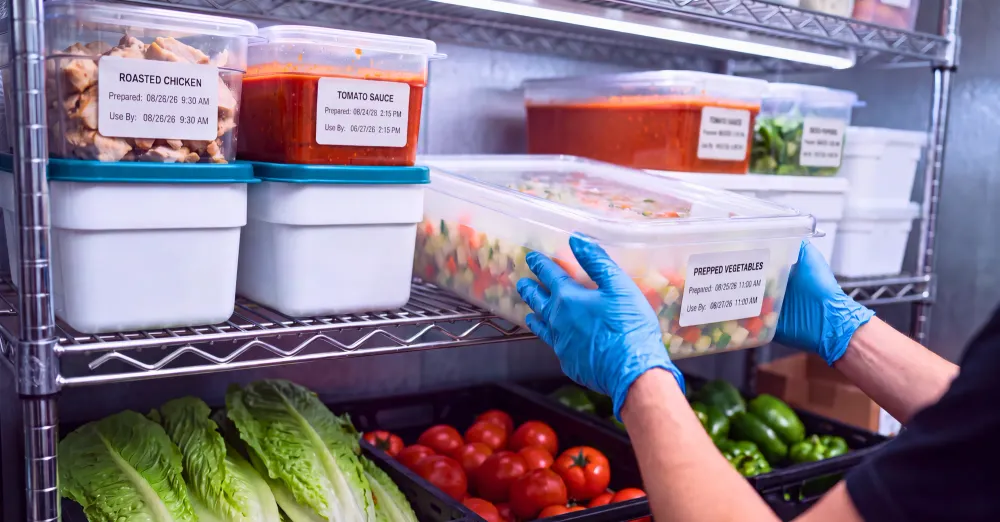
One location trains new hires to put new stock in the back and pull from the front. Simple, and for years it works, because most of the time the oldest delivery really does expire first. Then a supplier ships a rush batch with a shorter shelf life than what's already on the shelf, a line cook restocks it behind the older case out of habit, and now the newer product is quietly expiring first while sitting in the back where nobody rotates from.
That's not a training failure. It's the exact edge case that First In, First Out was never built to catch, and at a single location with a hands-on manager, it usually gets caught anyway, by someone glancing at a date during prep. Multiply that same gap across 30 locations, three shifts each, and “usually gets caught” stops being a food safety plan.
First In, First Out means exactly what it sounds like: whatever arrived first gets used first. In practice, that means stocking new deliveries behind existing inventory and pulling from the front, so product moves through in the order it came in the door.
It's simple to teach, which is most of why it's the default. It's also the reason it's the single most tested definition in food handler certification, because “put new stock in back, pull from the front” is the kind of instruction that survives high turnover and minimal training time. That's a real strength, not a flaw. The flaw shows up specifically when receiving order and expiration order disagree.
First Expired, First Out means using whatever expires soonest first, regardless of when it arrived. Most of the time, FIFO and FEFO tell you to do the same thing, because oldest-received and soonest-to-expire are usually the same case of product. They diverge when they aren't: a shorter shelf-life production lot, a supplier substitution, a rush delivery that skipped the normal receiving cadence, or simply two products with different natural shelf lives sitting in the same prep cooler.
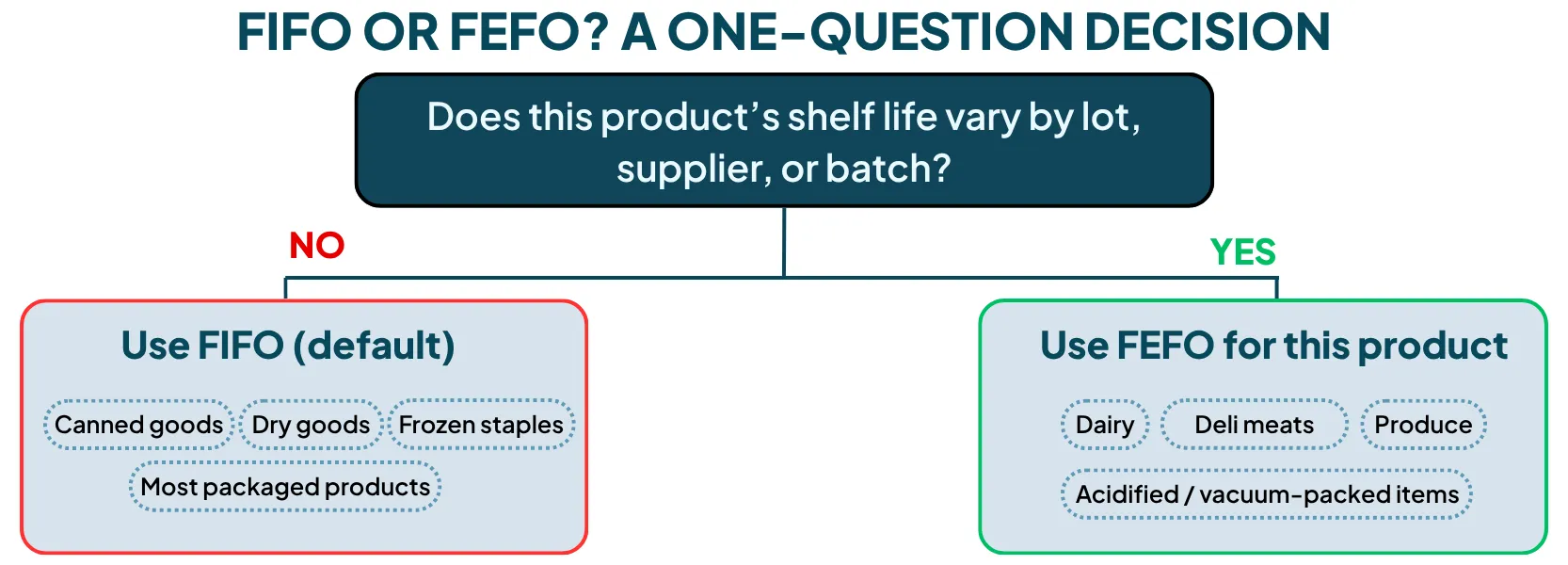
FEFO requires reading the actual date on the product, not just its position in the rotation. That's a heavier lift than “back of the line, front of the line,” which is exactly why FIFO remains the default for training and FEFO gets reserved for the products where the two methods actually disagree, like dairy, deli, produce with variable ripeness, and anything acidified or vacuum-packed with its own shelf-life clock (worth reading alongside how sushi rice's own pH-based shelf life works, a related case where the expiration clock and the received-date clock aren't the same thing at all).
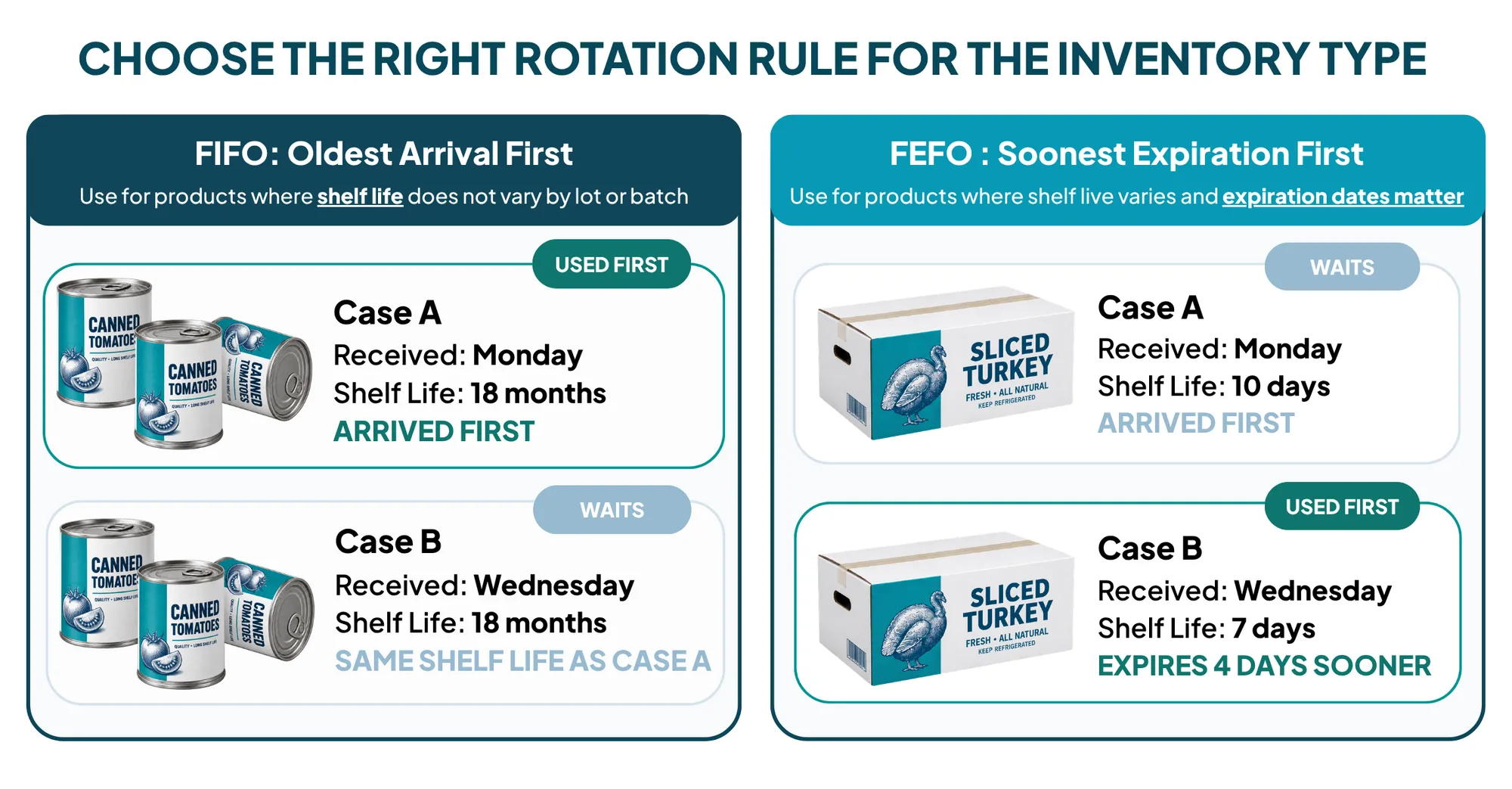
A grocery deli gets deliveries the same way for almost everything on the shelf: one case Monday, another case of the same item Wednesday. For most products, that pattern alone settles the rotation question. For a few, it doesn't, and the difference is worth seeing side by side.
Canned tomatoes carry the same shelf life no matter which production run they came from. A case from Monday and a case from Wednesday are both good for 18 months from the day they were canned, so the oldest arrival is always the soonest to expire. FIFO gets the right answer here every time, without anyone reading a date.
Sliced turkey doesn't work that way. Shelf life is set by the production date on that specific case, not by the SKU, so two deliveries of the same item can be running two different clocks. Monday's case has a 10-day shelf life. Wednesday's case comes from a different production lot with only 7 days on it, so it expires four days before Monday's case does, despite arriving two days later. Oldest arrival stops being a reliable stand-in for soonest to expire, which is exactly the condition the decision flow above is built to catch.
Get that wrong at one location and it's four days of unnecessary waste, or worse, product served past a safe window because everyone was watching arrival order instead of the number printed on the label. Get it wrong the same way across 50 locations, and it's not an isolated mistake anymore, it's a gap in the standard itself.
None of the individual pieces of this are hard. Reading a date, rotating stock, retraining a new hire, that's day-one kitchen work. What breaks isn't the task, it's the fact that nobody's watching it happen the same way at every site:
| What breaks | Why it's worse at scale |
|---|---|
| Inconsistent labeling | One location writes dates on tape, another uses a stamp, a third skips it on “obvious” items. Nothing is comparable across sites. |
| No standard on which method to use, and when | Without a documented rule for which SKUs need FEFO instead of default FIFO, each site manager decides on their own, which means every site decides differently. |
| High turnover, low retraining cadence | A rule that lived in one manager's head doesn't survive them leaving, and multi-unit turnover means that happens constantly. |
| No visibility until something fails | A single kitchen's problem shows up in a next-day prep check. A multi-location chain often only finds out during a health inspection, a customer complaint, or a waste audit weeks later. |
| Waste and shrink hidden in noise | Rotation failures read as ordinary spoilage in a P&L unless someone is specifically tracking it as a rotation issue, which most locations aren't. |
Invisible shrink is the hardest to fix. While a single location's inventory loss gets brushed off as normal cost of business, scaling that exact waste percentage across an entire chain quietly drains your net margins.
Enforcing a single standard across sites that operate independently, day to day, without a manager physically checking every walk-in, comes down to a small number of things actually working:
Rotation failures don't only show up as wasted product. Ready-to-eat TCS food that's been in a cooler too long, or acidified and packaged product held past its safe window, is a direct line back to the same hazards a temperature danger zone failure creates, because time and temperature control depends on knowing exactly how long something has actually been held, not how long someone assumes it's been held. The FDA Food Code's date-marking requirement exists specifically to control for Listeria monocytogenes growth in refrigerated ready-to-eat product, which is a real hazard, not a paperwork formality.
That's also why this belongs next to your broader food safety and compliance program rather than off to the side as an inventory nicety, and why it's a fair question to ask of any restaurant inventory app or food safety management software you're evaluating: does it actually track rotation and expiration as part of the record, or just the count. It's also the same recordkeeping muscle that traceability regulation is starting to require directly, not just recommend, which is worth its own conversation as those requirements phase in. The same standardization argument that applies to temperature logs and critical control points applies here: a rule that only works when someone's watching isn't a rule an enterprise operation can rely on.
FIFO and FEFO agree most of the time, and disagree exactly when it matters: a shorter shelf-life product arrives after a longer-lived one already on the shelf. FIFO is the right default because it's simple enough to train fast and survive turnover. FEFO is the correction for the specific products where receiving order and expiration order don't match. Neither one holds up across multiple locations without a documented standard, a consistent labeling method, and a way to check compliance that doesn't depend on a manager remembering to look. Get that structure in place once, and it scales the same way at location one and location fifty.
First In, First Out: the oldest inventory, based on when it arrived, gets used first.
First Expired, First Out: whatever expires soonest gets used first, regardless of when it arrived.
FIFO rotates by arrival order. FEFO rotates by expiration date. They usually produce the same result, except when a newer delivery has a shorter shelf life than stock already on hand.
Not entirely. Most operations use FIFO as the default and apply FEFO specifically to products where shelf life varies by lot, like dairy, deli meats, produce, and anything with its own acidification or packaging-based shelf-life clock.
There's no single legal requirement, but a routine schedule, not just during a formal inspection, is what catches a drift before it becomes a violation or a waste problem.
Assuming a rule that works when one experienced manager is watching will hold up the same way across every shift, every location, without being written down and checked on a schedule.
Yes. Under the FDA Food Code's date-marking rule, combining product prepared on different dates means the whole batch carries the earliest of those dates, not the most recent one.
Both. Expired-but-unrotated TCS food is a direct time-and-temperature hazard, not only a shrink number on a P&L.
Yes. Traceability means being able to answer, for any product on the shelf, when it arrived, when it expires, and how it was rotated. A FIFO or FEFO rule that isn't logged anywhere isn't traceable, no matter how consistently it's actually followed.
Whether it tracks expiration and rotation as part of the record, not just item counts and reorder points. Plenty of inventory software manages stock levels well and says nothing about whether the oldest or soonest-expiring product is what actually got used.
Get the latest industry insights delivered straight to your inbox
Browse