Stay in the loop!
Get the latest industry insights delivered straight to your inbox
Nobody sets out to build a fragmented tech stack. It accumulates one good decision at a time. Here is how to tell which seams in your back of house are worth paying to close, and which ones are fine exactly as they are.
Dana Loof
Ask a director of operations how they ended up with eleven systems in the back of house and you will not hear a strategy. You will hear a history.
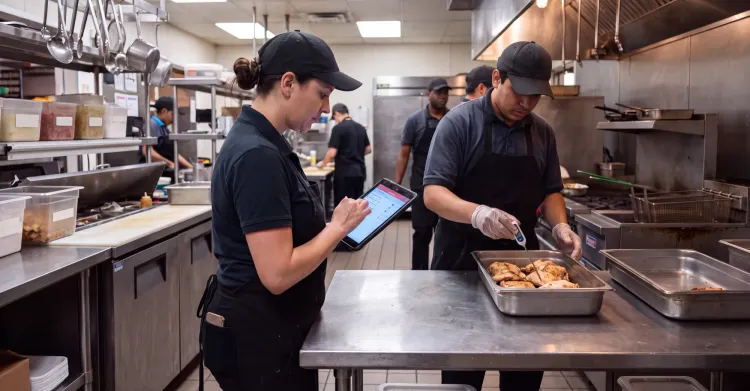
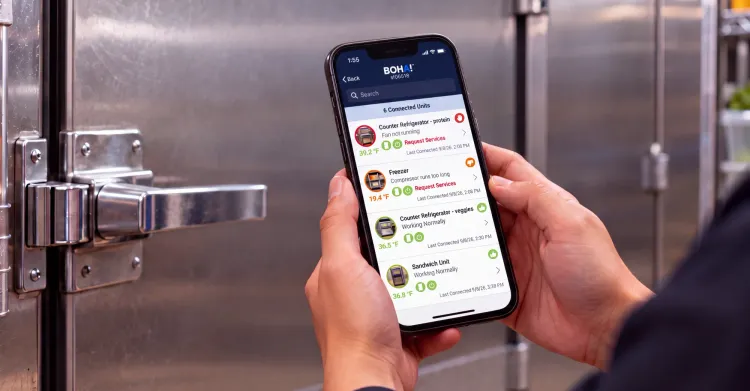
The temperature logs went digital after a health department visit. The labeling system came in when the state adopted new date-marking rules. Somebody piloted a task app at four locations because a regional manager was tired of chasing paper checklists, and it worked well enough to roll out. Each of those was a defensible call made by a competent person solving a real problem. The trouble is that nobody was ever assigned to own the shape they made together.
That is how a restaurant tech stack becomes fragmented, though most operators only learn terms like tool sprawl after they are already living in it. Not through bad decisions, but through good ones made in sequence, each one correct in isolation and none of them evaluated against the whole. The result is a back of house where the data exists but nobody can assemble it, and where the person who ends up reconciling it is whoever sits closest to the P&L.
The industry is starting to name this. In the 2026 Restaurant Technology Outlook Market Leader Report from Informa Foodservice, a survey of nearly 500 foodservice operators, one in five named data silos across vendors as one of their biggest tech stack challenges of the year. The same survey found the share of operators buying best-of-breed point solutions fell to 24% from 31% the year before. That's a correction, not a fad, from operators who have started pricing in what a new vendor costs them in integration and support, not just what it costs on the invoice.
That advice, consolidate, connect, stop buying point solutions, is everywhere right now. It's not wrong, and you will hear a version of it from every vendor with a platform to sell, including us. What that advice usually skips is which of your eleven systems should actually be folded together first. Treating every seam the same is how consolidation projects stall six months in, and the seam, not the platform-versus-point-solution label, is the part actually worth deciding on. That's what the rest of this is about.
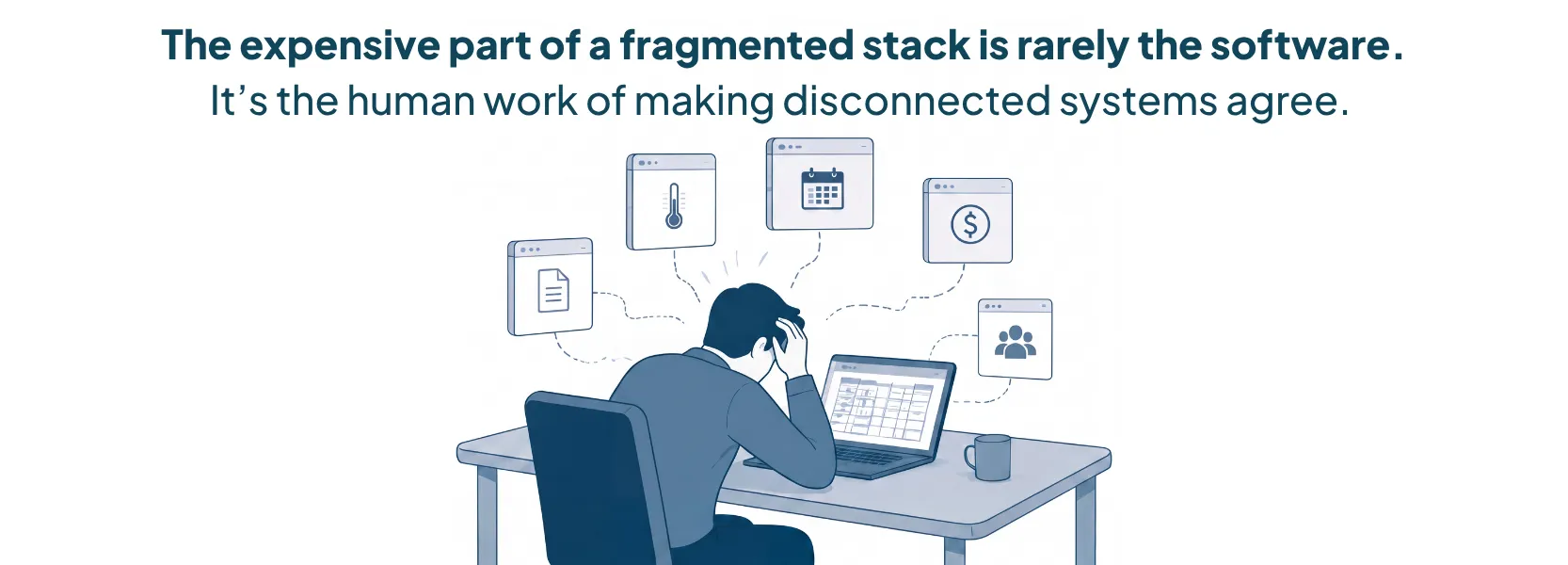
The expensive part of a fragmented stack is rarely the software. It is the human work of making disconnected systems agree. That work is real but nearly invisible, because it never appears as its own budget line. It shows up as a district manager building the same weekly report by hand from four exports. It shows up as a food safety director who can tell you compliance rates by location but cannot cross them against temperature excursions without a spreadsheet and an afternoon. It shows up in what one restaurant technology executive described in that same report as tech partners that "don't play well together on purpose."
There is a second cost that gets even less attention, and it lands on the people furthest from headquarters. Every additional system is another login, another interface, another training module for a crew with real turnover. A shift lead who has to touch five apps to close out a night will eventually start skipping the ones with the least immediate consequence, and the ones with the least immediate consequence are usually the compliance records. The stack degrades quietly at the location level long before anyone at headquarters sees a number move.
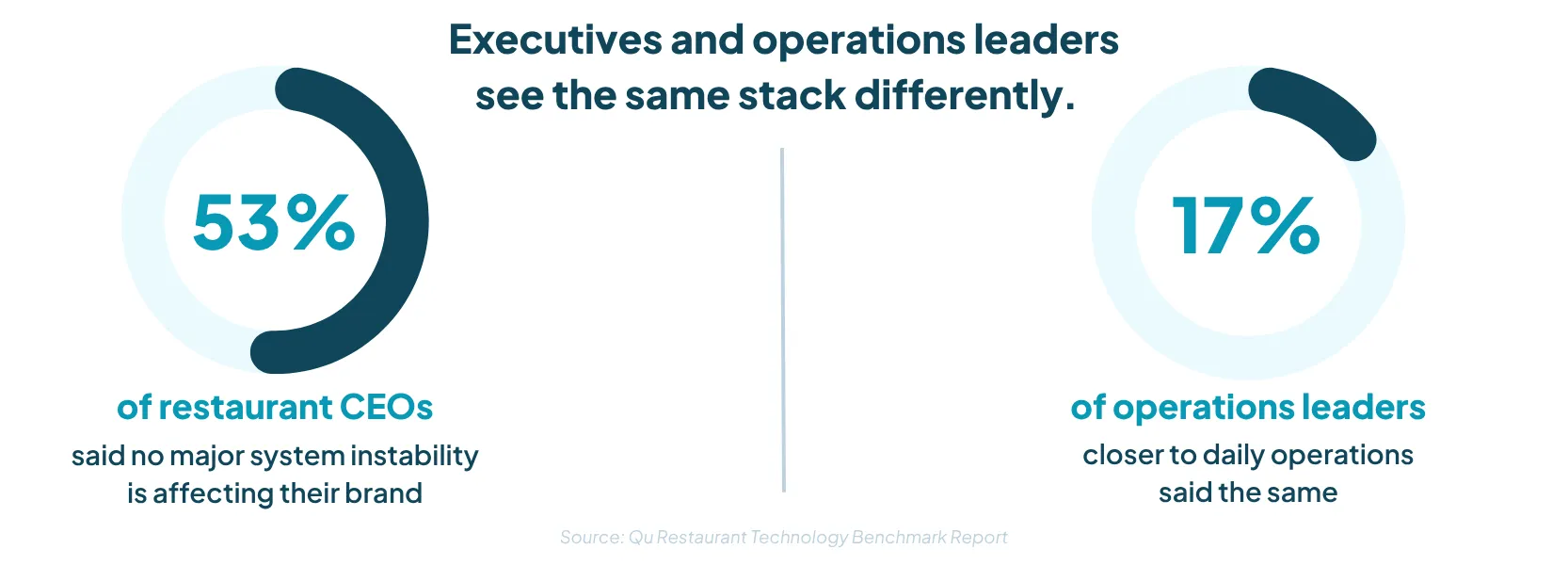
That gap between what headquarters believes and what the field experiences is measurable. In Qu's Restaurant Technology Benchmark Report, 53% of restaurant CEOs said no major system instability was affecting their brand, while only 17% of the leaders closer to daily operations said the same. Executives and operators are looking at the same stack and seeing different things.
This deserves to be said plainly, because the consolidation conversation tends to flatten into a slogan.
A specialized tool built by people who think about one problem all day is often genuinely better at that problem than a platform module. That is a real advantage and it does not disappear because consolidation is trending. There are also cases where a point solution is simply the right answer: a capability so specific to your operation that no platform covers it, a system your franchisees already own and will not replace, or a piece of equipment-adjacent software that came with the equipment.
Either way, the seam is what decides this, not the label a tool started with.
Some seams are cheap. If a system produces a monthly export that one person reviews and nobody makes decisions from in real time, the seam costs you almost nothing. Other seams are expensive, and they tend to share a trait: they sit between two systems that describe the same event. When your temperature monitoring and your task completion records live in separate places, you have two accounts of the same shift, and reconciling them is a standing tax on somebody's week.
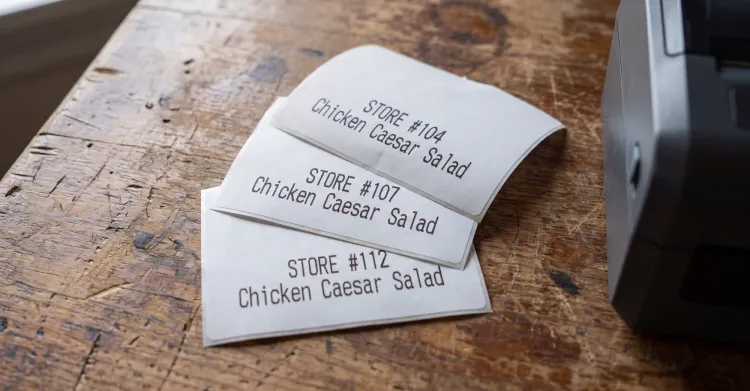
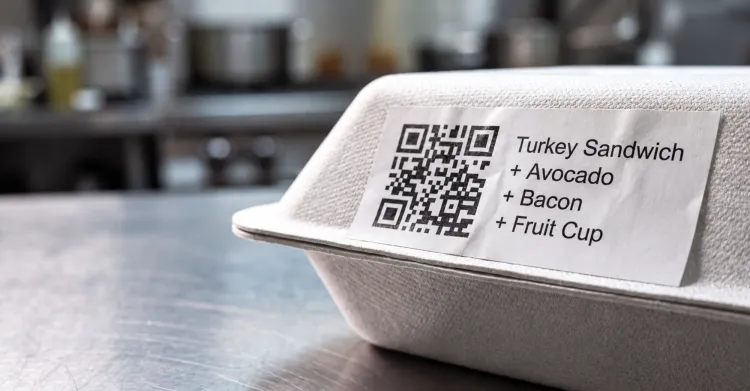
You can watch the same mechanic play out whenever an operator expands into a new channel. When a location starts fulfilling catering and commissary orders, the labeling standard that already runs the in-store case either extends to the new channel automatically, or it becomes a second system to maintain. Either way, that's the same reconciliation tax showing up under a different name.
When systems that describe the same operation share one record, a few things change in ways that are worth naming concretely.
Verification becomes easier when related operational data lives within the same platform. When digital checklist completion, temperature readings, and corrective actions are visible together, teams spend less time proving that the work happened and more time acting on exceptions. The record is the proof, and the corrective action is attached there, instead of living in an email thread.
Patterns become visible at the level where you can act on them. A single location logging late is noise. Nine locations in one region logging late for three straight weeks is a coaching problem with a name and an address, and it only surfaces if the underlying records roll up somewhere queryable. That is the practical case for a back-of-house operations platform over a shelf of separate tools: not that any single app is better, but that the questions leadership actually asks tend to cross app boundaries.
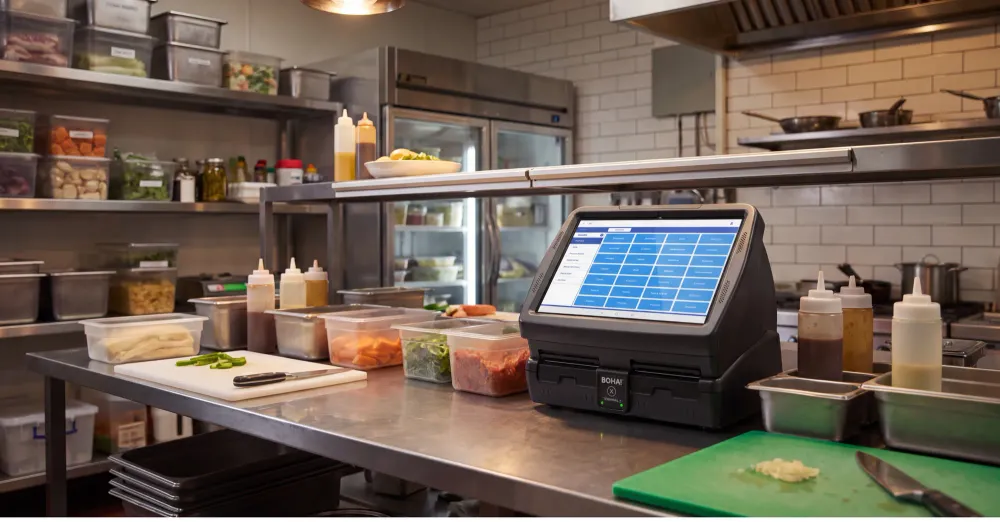
And the burden on the crew goes down rather than up. A connected workflow for prep, labeling, temping, and task completion, supported by hardware built to work seamlessly with the same platform, is the difference between a closing routine a new hire can learn in a shift and one they will quietly abbreviate. That gap is bigger than "marginally nicer," and it is the part consolidation pitches tend to undersell because it is hard to put on a slide.
You do not need a rip-and-replace to make progress here, and treating consolidation as an all-or-nothing project is usually what stalls it. A more useful approach is to inventory your seams rather than your systems.
Start by listing the questions leadership asks that currently require someone to open more than one system to answer. That list is short, specific, and it is your actual consolidation roadmap. Then look at which of those questions concern food safety or brand standards, because those are the ones where a delayed answer carries regulatory or reputational cost rather than just annoyance. Close those seams first.
→ Download the vendor consolidation checklist, a worksheet version of this exact framework: inventory your systems, run a two-question test on each seam, and set your priority order. Built for working it location by location or once for your whole footprint.
The operators who navigate this well share one habit: they can articulate, before they buy anything, which seams are costing them real money and which are fine left open. That distinction is the whole exercise, and it is worth doing before a vendor does it for you.
What is SaaS sprawl?
SaaS sprawl, also called tool sprawl, is what happens when an organization accumulates more software systems than anyone is actively managing as a set, each one added to solve an immediate problem without evaluating how it fits with what already exists. In a restaurant or c-store back of house, it typically shows up as a temperature monitoring app, a labeling system, a task checklist, and a handful of other point solutions that were each the right call individually but were never evaluated together.
What is the difference between a point solution and a platform?
A point solution is software built to handle one specific job, such as temperature monitoring or labeling. A platform handles multiple related jobs on shared infrastructure, so the data from each function lives in one place. The practical difference comes down to whether the systems can answer a question spanning more than one of them without manual reconciliation, not how deep any single feature set runs.
Is consolidating restaurant technology always the right move?
No. Consolidation pays off where two or more systems describe the same operational event and someone is manually reconciling them. Where a tool runs independently and nobody makes real-time decisions from its output, the integration cost of consolidating often exceeds the benefit. The decision should be made seam by seam, not as a blanket policy.
What are the hidden costs of a fragmented tech stack?
The largest costs rarely appear as line items. They include manual report assembly across systems, delayed visibility into compliance gaps, duplicate data entry, and training burden at the location level. That last one compounds: each additional interface increases the chance that a shift lead abbreviates the workflow with the least immediate consequence, which is often the compliance record.
How do multi-unit operators evaluate back-of-house software?
The most useful evaluation starts with the questions leadership needs answered, not the feature list. If answering a routine question requires opening several systems and combining exports, that gap is the thing being purchased away. Operators also weigh how many separate interfaces a crew member must learn, since adoption at the location level determines whether any of the data is trustworthy.
Get the latest industry insights delivered straight to your inbox
Browse