Stay in the loop!
Get the latest industry insights delivered straight to your inbox
Cheap prep labels save on the invoice and cost more in rework, waste and inconsistency. Here's what a restaurant food labeling system should do, plus an 8-point checklist for comparing systems across dozens or hundreds of locations.
Tony Janega

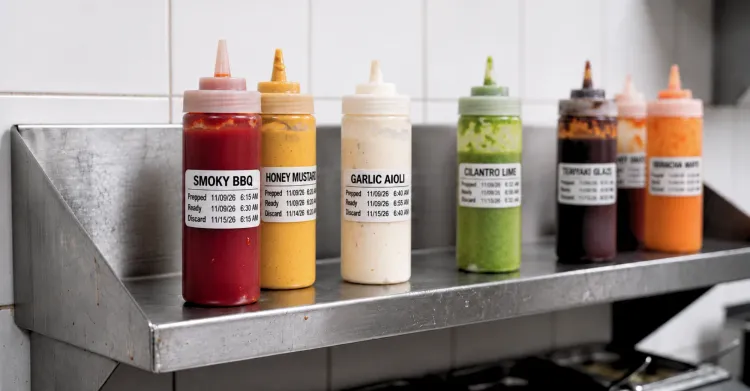
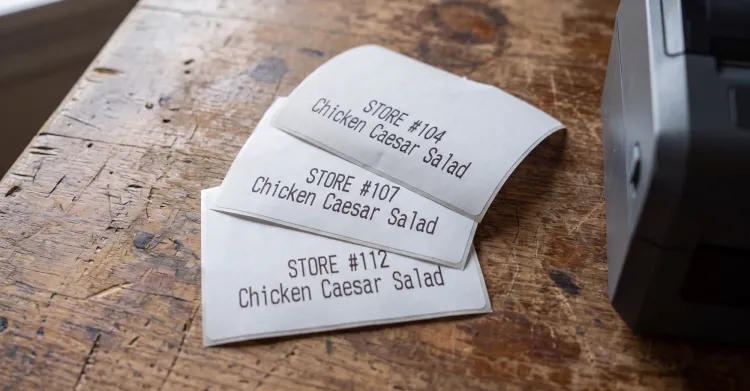
A food labeling system for restaurants is the software, printers and label stock a kitchen uses to produce prep, date code, allergen and grab-and-go labels. Instead of handwriting each one, a team member picks the item on a terminal, tablet or phone, and the system prints the product name, prep time, use-by date and any required ingredient or allergen details from a central menu. The goal is a label that's correct, readable and identical at every location, because the information comes from one source rather than someone's memory.
The label also carries compliance weight. The FDA Food Code requires ready-to-eat TCS food held longer than 24 hours to be date marked for no more than 7 days at 41°F or below, and food packaged on site for grab-and-go sale has its own labeling rules, including major food allergens. A labeling system that gets those details right every time takes a common inspection finding off the table.
In many kitchens, labeling is still treated as a supply decision. For operators managing prep volume, food safety routines, and multiple locations, a food labeling system for restaurants needs to do more than support the label order itself.
Labeling rarely looks like one of the larger cost decisions in a foodservice operation. Compared with labor, food cost, equipment, rent, or utilities, a roll of food prep labels can feel minor. Cheaper labels may appear to reduce spend without changing the way the kitchen operates, especially when the savings are multiplied across prep volume and locations.
The issue is that labels do not stay in the supply category once they enter the kitchen. They move with the food from prep into storage, rotation, shift handoffs, and waste decisions. A label that seems inexpensive at purchase can still create extra checking, rewriting, cleanup, and correction during the shift.
When labels work well, they disappear into the rhythm of the kitchen. The team can read the information quickly, trust that it is accurate, and keep moving. When labels do not work well, the cost usually shows up as extra handling inside the process rather than as a line item on the invoice. A smudged date, a peeling corner, unclear handwriting, or residue left behind from an old label can all slow the team down in small but repeated ways.
That is why the cheapest label is not always the lowest-cost choice. In a busy kitchen, labeling affects how consistently teams prep, store, rotate, verify, and use food throughout the day. That is also why many operators eventually start rethinking their food labeling system for restaurants as part of a broader operational strategy.
In many operations, labeling is evaluated by a narrow standard. If the label sticks and someone can write on it, it may be considered good enough.
That standard is too narrow for a real kitchen. A label has to remain useful after it is applied. It needs to stay readable in cold storage, hold up through handling, support rotation, and give the next person enough information to make the right decision quickly.
Cheap food prep labels often start creating hidden costs when they technically work at first but become harder to trust as the shift moves on. A label that smears, curls, leaves residue, or becomes difficult to read does not always cause an obvious breakdown. More often, it creates small interruptions that the team learns to work around.
A label is supposed to close a step in the process. Once a container is labeled, the team should be able to move on without returning to the same piece of information.
When a label smudges, peels, tears, or falls off, the task reopens. Someone has to confirm what the product is, check the correct timing, recreate the label, and place it back into the workflow. If the information is not easy to verify, the issue may pull in a manager or another team member who was not part of the original task.
This kind of rework is easy to miss because it blends into the normal pace of the kitchen. Nobody creates a report every time a label has to be rewritten, but the time still comes from somewhere. It comes out of prep, cleaning, stocking, service readiness, or the manager’s attention during a shift that is already moving quickly.
That is one of the hidden costs of a weak food prep labeling system. The problem does not always look like a labeling problem. It shows up as repeated reminders, recurring corrections, and small resets that slow the kitchen down over time.
A prep label might be harder to read than expected, or a handwritten time might require a second look before the product can be used. In some cases, residue from an old label keeps the new one from sitting cleanly on the container. The team may still get through the task, but the process now depends on someone pausing, checking, and confirming information that should have been clear from the start.
Those adjustments may be responsible in the moment. Over time, they can become part of how the kitchen operates. Instead of trusting the label, the team starts relying on memory, judgment, habit, and verbal confirmation.
The Food Code's date marking rules assume the date on a container can be read and trusted, since that date decides whether food gets used or thrown out. For operators, the harder part is keeping that accuracy through rush periods, cooler storage, wet hands, stacked containers and shift changes.
A restaurant food labeling system has to work in that environment, not just when the label is first applied.
Manual labeling can introduce variation before anything visibly goes wrong. Each handwritten label depends on the employee applying the same standard in the same way, even during a busy shift.
The next person who reads the label needs to understand the product, timing, format, and discard information without having to interpret someone else’s shorthand. When that work is done by hand, variation is almost inevitable. Strong teams can manage it, but managing it still requires attention. The more often the process repeats, the more chances there are for habits to drift between employees, shifts, and locations.
That variation is a bigger deal than it sounds because a label also controls timing, rotation, food safety and prep accountability. If the label format changes from person to person, the process becomes harder to audit and harder to scale.
For a single location, that may be manageable through training and oversight. For a multi-location operation, the same variation can become a larger execution problem. A food prep labeling system for restaurants should reduce those differences, not depend on every employee making the same judgment call in the same way. The same problem gets sharper with allergens, as New York's new allergen law shows in our look at manual labeling and the compliance cliff.
At one location, labeling problems can stay hidden for a long time because strong teams are good at adapting. They learn where labels tend to fail, which prep items need extra attention, and when a manager usually needs to step in. The kitchen keeps moving, but the process is relying on local knowledge instead of a standard that can be easily repeated.
Those informal fixes can be useful in the moment. They also make the real problem harder to see. If people are constantly compensating for weak labels, the process may appear to work even though it depends on extra judgment, memory, and correction.
That becomes more difficult as operations expand, a pattern many multi-unit operators have experienced as labeling workarounds become harder to manage across locations. A workaround that feels manageable in one kitchen can become a consistency problem across ten, twenty, or fifty locations. At that point, the issue is no longer just the label. It is the amount of local interpretation required to keep the labeling process on track.
Rewriting or verifying one label may not seem like a serious labor issue until the same correction repeats across prep stations, storage areas, shifts, and locations. Food prep labels are used too often for small inefficiencies to stay isolated.
The lost minutes add up, but the larger cost is how the work itself begins to change. Teams get used to checking around the label instead of relying on it. Managers start correcting the same kinds of mistakes. Prep becomes more reactive because the process depends on people catching issues as they happen.
Over time, those habits can become part of the operating model. The kitchen still functions, but it functions with more interpretation, more correction, and more dependence on individual judgment than a scalable process should require.
Labeling also affects how confidently teams decide whether prepared food can still be used.
When the product name, prep time, discard date, and handling information are clear, the decision is straightforward. When that information is smudged, missing, inconsistent, or hard to read, the team has to slow down and interpret the situation.
In many kitchens, the safest response is to discard the product. That may be the right decision for food safety, but it can still represent avoidable waste if the uncertainty came from a preventable labeling issue.
Across the industry, those small decisions add up. ReFED estimates U.S. foodservice generated 12.5 million tons of surplus food in 2024, worth about $157 billion. Inside a single kitchen, labeling is one of the smaller control points that can either reduce that uncertainty or add to it, along with rotation practices like FIFO and FEFO.
Cheap labels become more expensive when unclear information leads to product being thrown away. At that point, the operation is paying for more than the roll of labels. It is also absorbing the waste created when the team cannot confidently trust the information attached to the product.
When labels stay attached, legible and accurate, a team member can pull a container, confirm the timing at a glance and keep moving, and that's the standard a food prep labeling system should be held to. The invoice shows what a roll of labels costs. It doesn't show the rework, the discarded product or the manager time spent keeping every store on the same format. These eight questions help compare systems on what they cost after the label is applied, which is where the real difference between them shows up.
| Question to ask | What a strong answer looks like |
|---|---|
| 1. Can headquarters change an item once and have it reach every location? | One central menu, so a new shelf life, ingredient or allergen updates every store's labels at the same time (see how one ingredient update reaches every label). |
| 2. Does the system calculate use-by dates? | Dates come from each item's shelf-life rule, so no one types or handwrites them. |
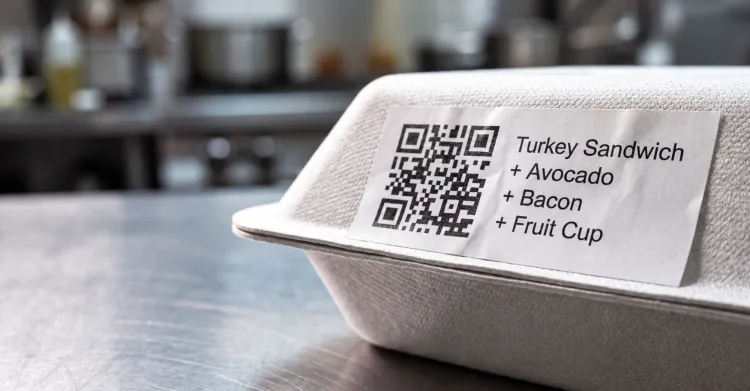
| 3. Do grab-and-go labels pull ingredients and allergens from the item record? | Ingredient, allergen and nutrition details print from the same record the kitchen uses, with nothing retyped. |
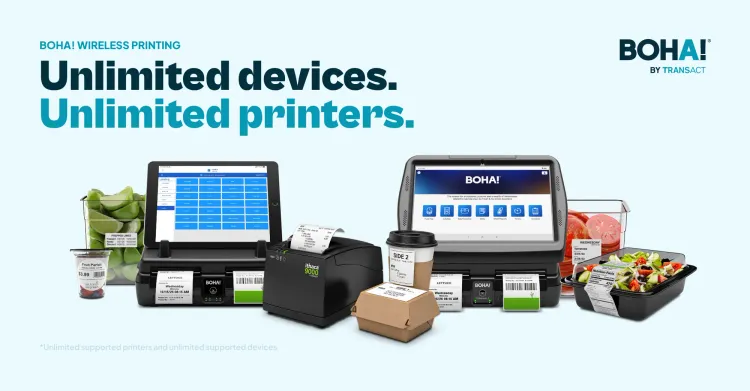
| 4. How do devices connect to printers? | Any supported device can print to any printer on the location's network. Many systems pair one tablet to one printer over Bluetooth, so every new prep station means another pairing or another device. |
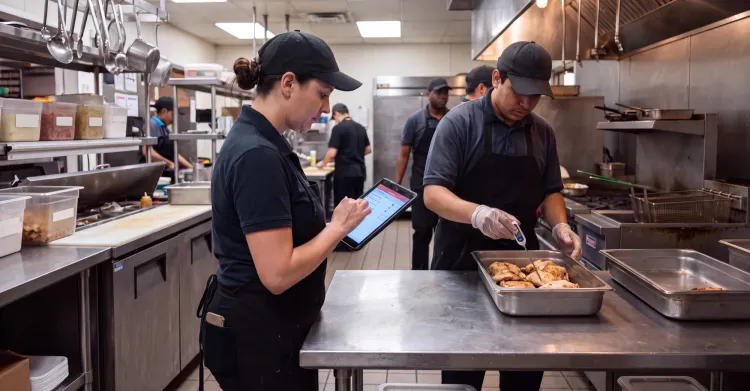
| 5. Can teams print from a fixed station and from mobile devices? | Both, so long label runs stay at the terminal while small, frequent prints start at the prep table or the line. |
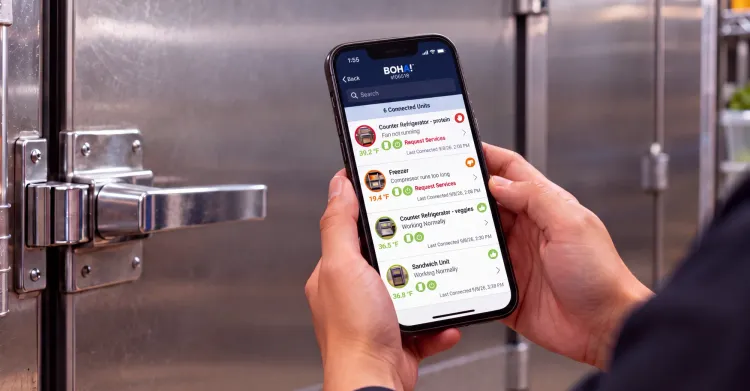
| 6. Is labeling connected to the rest of the back of house? | Labels, timers, checklists and temperature records live on one platform with one login and one record, rather than in a standalone labeling app. |
| 7. Does the label stock fit each job? | Options for food prep, dissolvable, removable and grab-and-go labels that stay readable in coolers and wet prep areas. |
| 8. Who supports the hardware and the software? | One vendor for both, so a printer problem and a software problem go to the same team. |
To size total cost, pick one location and track a normal week: labels rewritten, prepared items discarded because the date was unclear, and the minutes managers spend correcting labels. Multiply that by your store count and compare it with the price difference between label options.
BOHA! Labeling was built for the multi-location version of this problem, with the software and the label hardware designed to work together:
The result is one labeling standard every store can follow without extra effort, and fewer of the small, invisible costs that cheap labels hide. To see what that looks like in your kitchens, explore our food prep and labeling solutions.
Cheap food prep labels can become expensive when they create extra work after they are applied. If labels smudge, peel, leave residue, or become hard to read, teams may spend more time rewriting labels, confirming information, cleaning containers, or discarding food that cannot be clearly verified.
Hidden labeling costs can include rework, wasted product, extra manager oversight, inconsistent label formats, and slower prep decisions. These costs may not appear on the label invoice, but they can affect labor, food safety routines, waste, and back-of-house consistency.
A food labeling system for restaurants should help teams apply consistent product names, dates, times, discard information, and label formats across shifts and locations. It should also support clear food rotation, reduce manual interpretation, and hold up under real kitchen conditions.
Unclear food labels can lead to waste when teams cannot confidently verify what a product is, when it was prepared, or whether it is still safe to use. In those cases, discarding the product may be the safest choice, even if the food might otherwise have been usable.
Food prep labeling matters more at scale because small labeling issues repeat across more employees, shifts, prep stations, and locations. What one team can work around manually may become harder to standardize across a multi-location operation.
It depends on the number of printers and devices, the software subscription and the label stock. Compare total cost rather than label price: add up rewritten labels, food discarded because a date was unclear and the manager time spent correcting labels at one location, then multiply by your store count.
A label printer only prints. A food labeling system integrates the software that holds your menu, calculates use-by dates, pulls ingredients and allergens and keeps every location on the same format, so the printer outputs the right information every time.
It depends on how the system connects. Bluetooth pairs one device with one printer. Systems that print over the location's Wi-Fi network, such as with BOHA! wireless printing, let one printer serve many supported devices and one device print to many supported printers.
Get the latest industry insights delivered straight to your inbox
Browse