Stay in the loop!
Get the latest industry insights delivered straight to your inbox
A cooler running a few degrees warm rarely looks like a failure, until product quality slips. BOHA! Sense gives foodservice teams around-the-clock remote temperature and humidity monitoring across refrigerators, freezers, and walk-ins, so equipment drift gets caught before it turns into food loss.
Stephen Crump
A cooler running a few degrees warm. A freezer taking longer to recover after a delivery. A walk-in whose humidity has been creeping up overnight. None of these looks like a failure, and in a busy kitchen they are easy to miss until product quality slips or someone asks what the temperature logs actually show.
BOHA! Sense is a remote temperature and humidity monitoring system for foodservice equipment: refrigerators, freezers, walk-ins, and dry storage. Wireless sensors track conditions around the clock and alert the team when a piece of equipment drifts out of its normal range, so someone can respond before a small change turns into food loss, a food safety risk, or costly equipment repair, even worse replacement.
It does not replace people or maintenance, it enhances response time and awareness. BOHA! Sense enables earlier, more consistent visibility versus a single manual check at one point in the day, so problems are easier to catch, investigate, and document.
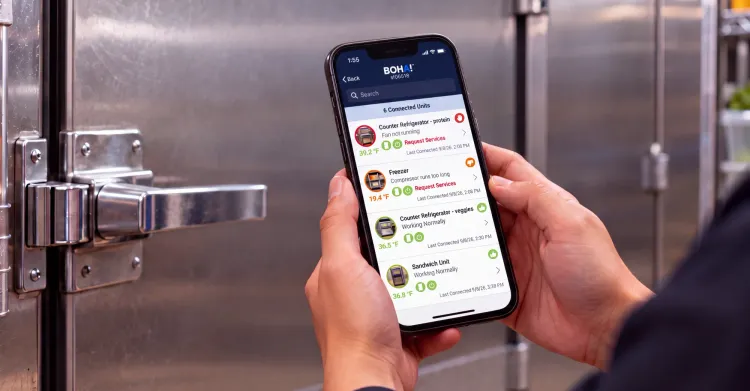
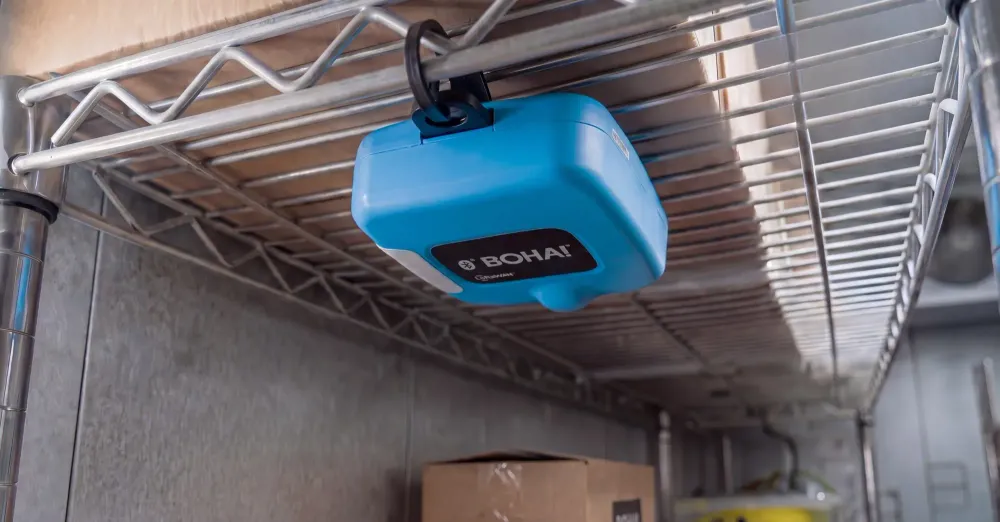
BOHA! Sense pairs small, rugged wireless sensors with a gateway that gathers data, sending it to the BOHA! platform, accessible via the BOHA! Sense mobile app on iOS or Android, and the BOHA! Control Center. The sensors sit inside refrigerators, freezers, walk-ins, and dry storage and report temperature and humidity continuously, day and night.
What it brings to the kitchen:
One point on scope, because it matters: BOHA! Sense monitors temperature and humidity conditions to keep product safe. What it gives a team is real-time visibility into how their refrigerated environments are behaving, so they know when something moves out of range. It won’t solve the problems by itself, but makes the problems visible, allowing teams to take action sooner and ensure product remains high quality and food safe for patrons.
Waste and spoilage reduction depends on catching problems early enough to respond. BOHA! Sense gives users that early warning. It makes equipment conditions visible so teams can act, moving product, checking equipment, or escalating, before spoilage spreads and costs rise. Over time, equipment monitoring visibility helps operators reduce the avoidable food loss that can quietly and quickly kill quality and drive up food costs.
The same visibility supports food safety and compliance. Continuous temperature and humidity records show whether refrigeration, freezer, walk-in, and storage conditions stayed within expected ranges; and, when corrective action is needed, it’s done promptly and recorded, strengthening food safety documentation and audit readiness. Sense data rounds out the picture alongside BOHA! Temp and the wider visibility a multi-location team gets through Control Center.
The value tends to show up initially in the moments when manual checks miss.
A busy service has the fridge door open for long periods of time, resulting in more food on tables, but also an overworked and overheating refrigerator. This will affect costly and sensitive items like fruit and vegetables, but it could get way worse if the problem persists. With Sense, a walk-in cooler that drifts warm overnight can be flagged before the morning crew arrives. A drink fridge that recovers slowly after a big delivery shows a pattern worth investigating. A reach-in near a hot line that keeps running warm will not keep food at optimal freshness and may point to a failing compressor rather than a placement problem. And across many locations, an issue that looks like a one-off at a single store can turn out to be an operational pattern worth investigating. This kind of refrigeration monitoring, backed by a history of readings, helps teams tell whether a problem is isolated, recurring, or spreading.
Earlier visibility can surface behaviors, like doors left open during a rush, that put extra strain on equipment over time, so teams can address them sooner.
When a refrigerator, freezer, or walk-in drifts out of range, the cost rarely stops with the food inside it.
First, there is the product that may need to be discarded. Then there is the replacement of food inventory, the labor spent checking and moving product, the service call and cost of repair (or worse, replacement), and the operational disruption if a menu item, grab-and-go case, prep station, or production schedule is affected.
Together, those costs can turn a refrigeration issue into a four- or five-figure operational event. FDA food safety guidance underscores how quickly perishable food becomes a discard risk when refrigeration is interrupted, while commercial refrigeration repair estimates often put major walk-in repairs, such as compressor replacement, in the low-thousands range. Add discarded product, replacement inventory, emergency service, labor, lost sales, and customer impact, and a downed walk-in can reasonably become a $5,000 to $20,000+ incident depending on inventory value, downtime, and operating volume.
That’s why real-time refrigeration monitoring has become an important part of how foodservice teams reduce risk before small equipment issues become larger operational costs. In some cases, teams may also need to document what happened, when it happened, and what corrective action was taken.
That cost stack can include:
BOHA! Sense provides visibility into the health of your equipment and helps teams stay ahead of changes before they turn into major problems. When teams know that a cooler is drifting warm, a freezer is recovering slowly, or a storage area is moving outside its expected range, they have a better chance to act before the issue becomes more expensive.
For multi-location operators, that visibility matters even more. One equipment issue at one location is a store-level problem. The same pattern across many locations can point to training gaps, equipment placement issues, door-open behavior, maintenance needs, or broader operational risk.
Large operators are also under more pressure to understand and document how large, food safety-dependent systems and equipment, like refrigeration, are performing. In 2026, Grocery Dive reported that Kroger agreed to pay a $2.5 million civil penalty and spend $100 million over three years to retrofit or replace 600 refrigeration units as part of a proposed settlement involving refrigerant leaks and Clean Air Act compliance.
BOHA! Sense isn’t a refrigerant leak detector. But the Kroger case is a useful reminder that refrigeration-related issues can become major operational and financial problems when they are hard to detect early, track consistently, or address before they escalate, especially over a distributed network of locations. At scale, refrigeration visibility, maintenance, and documentation are not just store-level concerns – they become enterprise-level issues.
It’s worth drawing a clean line between two BOHA! tools that both deal with temperature and food safety but solve different problems.
BOHA! Sense monitors the environment. It tracks equipment and the conditions that keep food fresh: the temperature and humidity inside refrigerators, freezers, walk-ins, and storage, around the clock to make sure optimal conditions are maintained to keep food fresh.
BOHA! Temp supports active food temperature checks. It supports staff in their daily food safety workflows with active food temperature checks, corrective actions, and audit-ready HACCP records.
In simple terms: BOHA! Sense and BOHA! Temp work together. Sense watches the food storage conditions, and Temp guides and documents the checks on the food itself.
| Operational Need | BOHA! Tool |
|---|---|
| Always-on temperature and humidity monitoring of equipment | BOHA! Sense |
| Alerts when a fridge, freezer, or walk-in drifts out of range | BOHA! Sense |
| Guided food safety processes, recommended corrective actions and HACCP records on demand | BOHA! Temp |
| Operational checklists, workflows, and task verification | BOHA! Checklist |
| Prep, date-code, and grab-and-go labeling | BOHA! T2 or WorkStation |
| Receipts and tickets at the order counter or back-of-house station | Ithaca 9000 |
BOHA! Sense is best suited for operators who want continuous visibility into the equipment that helps keep food safe, rather than relying only on distracting, time consuming, manual checks at various points in the day.
BOHA! Sense can be a strong fit for teams that need:
Sense adds a monitoring layer to the BOHA! hardware portfolio. Where BOHA! T2, WorkStation, and the Ithaca 9000 handle printing and labeling workflows, Sense keeps an eye on the equipment and conditions that affect food quality, food safety, spoilage risk, equipment status, and operational continuity.
BOHA! Sense watches equipment conditions in the background. But food safety also depends on active checks, corrective actions, and records that hold up during an inspection.
Next in BOHA! Built, we look at BOHA! Temp and how temperature workflows support audit readiness.
These questions cover what BOHA! Sense monitors and how it fits alongside BOHA! Temp.
What is BOHA! Sense?
BOHA! Sense is a temperature and humidity monitoring system for foodservice equipment, including refrigerators, freezers, walk-ins, and dry storage. Wireless sensors track conditions around the clock and alert the team when equipment moves out of range, so they can respond before food loss or a food safety issue escalates.
Does BOHA! Sense detect refrigerant leaks?
No. BOHA! Sense is not a refrigerant leak detector, and it does not replace HVAC/R service or maintenance. It monitors temperature and humidity, and alerts teams when conditions move out of range so they can investigate the cause.
What is the difference between BOHA! Sense and BOHA! Temp?
BOHA! Sense monitors equipment temperature and humidity continuously. BOHA! Temp supports active, daily food temperature checks, corrective actions, and audit-ready HACCP records. Sense watches the storage environment; Temp documents the checks on the food itself. Many operations use both.
How does BOHA! Sense help reduce food waste and spoilage?
It does not save food on its own. By alerting teams when refrigerators, freezers, or walk-ins drift out of range, and by building a history of conditions, BOHA! Sense helps teams respond earlier, moving product, checking equipment, or escalating, before spoilage spreads and drives up food cost.
Refrigerators, freezers, walk-in coolers and freezers, and dry storage areas. Wireless LoRaWAN sensors reach through heavy metal storage, and each reports temperature and humidity to the BOHA! app on iOS or Android.
Get the latest industry insights delivered straight to your inbox
Browse