Stay in the loop!
Get the latest industry insights delivered straight to your inbox
Most operators meet their HACCP plan the hard way — when an inspector asks to see it. Here's what HACCP actually is: the 7 FDA principles in plain kitchen terms, and how to run one across every location.
TransAct
Most operators meet HACCP the hard way: an inspector asks to see the plan, and someone starts digging through a binder nobody has opened since the last manager left. It doesn't have to be like that.
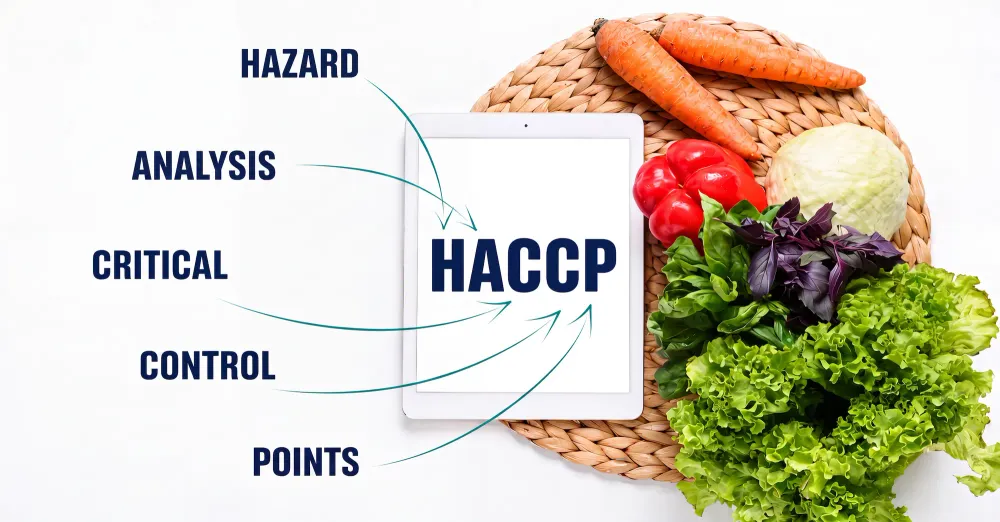
HACCP in one sentence: HACCP (Hazard Analysis and Critical Control Points) is a written food-safety system that finds the points in your process where food can become unsafe and puts specific controls in place to stop it. It's the logic behind almost every clean health inspection.
HACCP isn't paperwork for its own sake. It's a way of thinking about your kitchen that keeps people from getting sick — written down so anyone on the line can follow it, and so you can prove it happened. It started in the 1960s as a collaboration between Pillsbury, NASA, and the U.S. Army to keep astronauts from getting food poisoning in space, and it's since become the framework the FDA builds retail food safety around.

Hazard Analysis and Critical Control Points. Break it in half and it explains itself:
Everything else in HACCP is the machinery that makes those two ideas repeatable across every shift and every store.
Before you can control hazards, you have to know what you're looking for. HACCP groups them three ways:
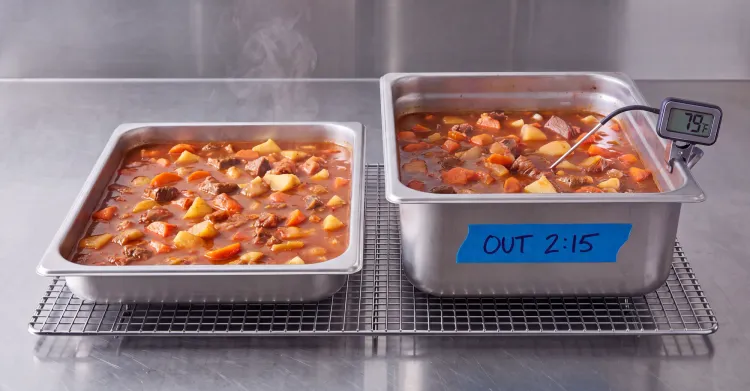
Most of your day-to-day risk is biological, which is why so much of HACCP comes down to time and temperature. (If you want the foundation there, start with what counts as a TCS food and the temperature danger zone.)
This is the heart of it. The FDA lays out seven principles, and they run in order — each one builds on the last. Here they are in kitchen terms.
| Principle | What it actually means | Kitchen example |
|---|---|---|
| Conduct a hazard analysis | Walk your menu and process; find where a hazard could get in | Raw chicken cross-contaminating a prep surface |
| Determine critical control points (CCPs) | Find the steps where you can actually stop or reduce the hazard | The cook step; the cooling step |
| Establish critical limits | Set the exact number that separates safe from unsafe | Cook poultry to 165°F |
| Establish monitoring | Decide who checks, how, and how often | Probe the thickest part of every chicken batch |
| Establish corrective actions | Decide what happens when a limit is missed — and record it | Re-cook or discard; log what you did |
| Establish verification | Prove the system is working | Calibrate thermometers; a manager reviews logs |
| Establish recordkeeping | Keep the documentation that proves all of the above | Temperature logs, corrective action logs |
Want the wall version? Print this one and tape it inside the walk-in. Get the free one-page HACCP quick-reference card →
If you only remember one thing about principle 7, make it this: if it isn't written down, as far as the health department is concerned, it didn't happen. A clean record of a problem you caught and fixed impresses an inspector more than a suspiciously perfect log.
People use the terms loosely, but they aren't the same thing.
HACCP is the specific, hazard-based system with the seven principles above. A broader food safety management system wraps HACCP together with your prerequisite programs — supplier controls, sanitation, personal hygiene, pest control. The FDA's model Food Code leans on the idea of "active managerial control," which is really just HACCP thinking applied to daily operations instead of living in a static document.
The short version for a multi-unit operator: the seven principles are the engine; the prerequisite programs are the chassis. You need both.
It depends on what you do. A full, formal HACCP plan is federally required for specific operations — juice, seafood, and USDA-regulated meat and poultry processing. Most retail restaurants aren't required to hold one unless they do something a health department flags as specialized: reduced-oxygen packaging (sous vide, vacuum-sealing), curing, smoking for preservation, or acidifying rice for sushi. Those usually trigger a HACCP plan variance from your local authority.
But here's the thing: whether it's legally mandatory or not, running your operation on HACCP logic is how you pass inspections and how you survive an outbreak investigation with your brand intact. The plan is the point, not the paperwork.
This is where it gets real for anyone responsible for more than one kitchen. A plan that lives in one good manager's head doesn't scale, and a plan that's different at every store is impossible to audit. Three things make it work across an estate:
This is the honest case for digital records over paper — not that digital is trendy, but that a temperature check logged on BOHA! Temp or a task confirmed on BOHA! Checklist becomes an audit-ready record HQ can actually see, instead of a clipboard in a drawer. Monitoring, corrective actions, and verification stop being three disconnected chores and become one record you can hand an inspector.
HACCP isn't exotic. It's hazard analysis, a handful of control points, the right limits, honest monitoring, and a record you can defend. The operators who sleep well are the ones who made those things automatic — at every location, not just the flagship.
Next: if you're ready to actually build one, read How to Build a HACCP Plan for a Restaurant (publishing Aug 6)
Is HACCP the same as ServSafe?
No. ServSafe is a food-safety training and certification program from the National Restaurant Association. HACCP is the underlying system that training teaches you to run.
What are the 7 principles of HACCP?
Conduct a hazard analysis; determine critical control points; establish critical limits; establish monitoring; establish corrective actions; establish verification; and establish recordkeeping.
How often should a HACCP plan be reviewed?
At least annually, and any time you change a menu item, a process, a supplier, or equipment that affects a critical control point.
Does a small or single-unit restaurant need HACCP?
The principles apply at any size — a single kitchen can run the same seven-principle logic on a one-page plan. Whether a formal, written plan is legally required depends on your processes and your local health department.
Get the latest industry insights delivered straight to your inbox
Browse